Build this interactive 3D experience as a single self-contained index.html that works offline. Keep the HTML, CSS, JavaScript, procedural geometry, textures, and shaders inline, with no external dependencies or downloaded assets. Use browser-native WebGL with a graceful fallback if unavailable. Support desktop and mobile, keyboard-accessible controls, pause/resume, and reduced motion. Keep animation smooth and rendering performance bounded.
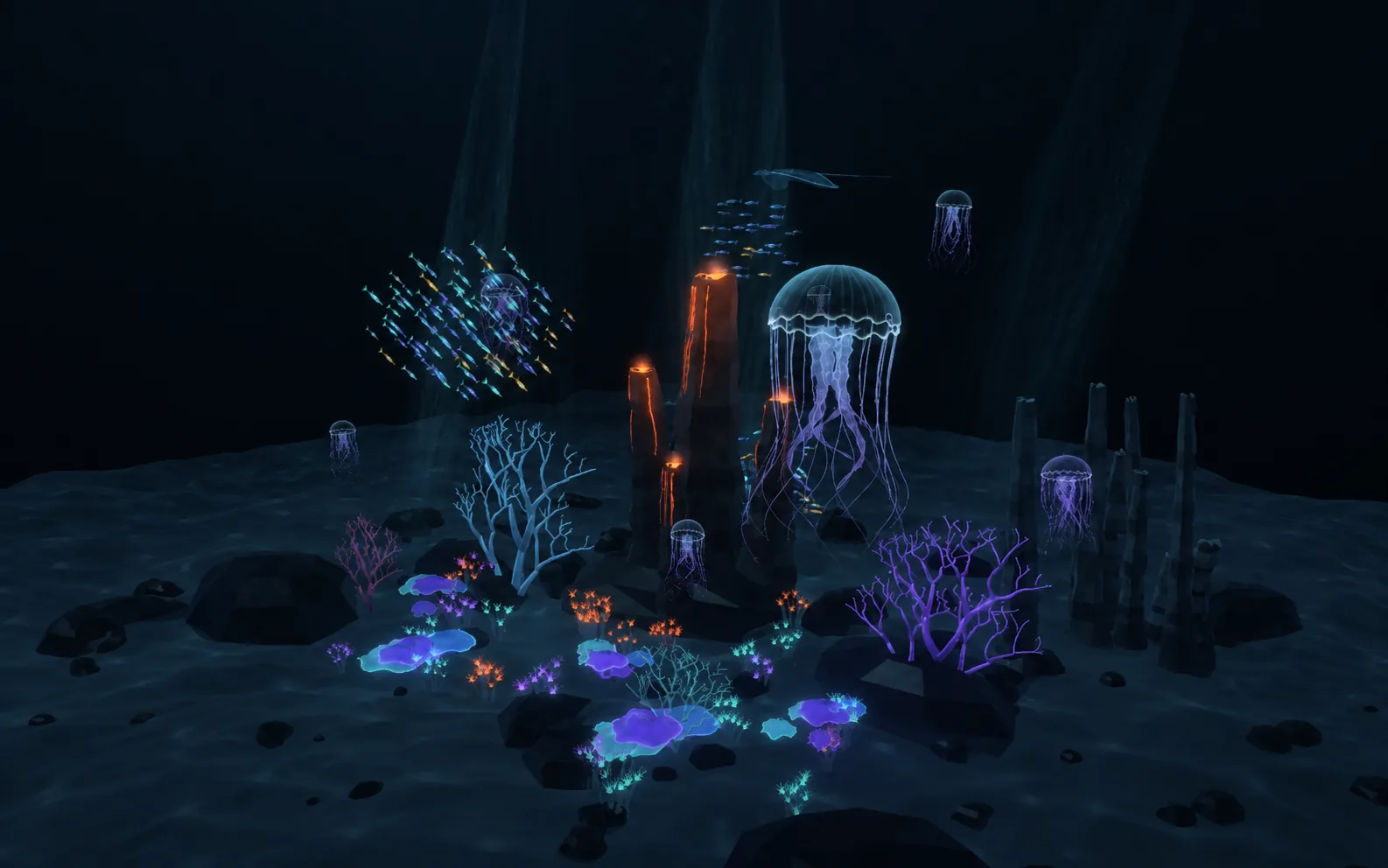
Render an original deep-ocean ecosystem surrounding a hydrothermal vent and towering procedurally grown coral or mineral formations. Establish strong depth with underwater fog, volumetric-looking light shafts, animated caustic approximations, marine-snow particles, and a dark abyss beyond the habitat. Populate the scene with multiple believable behaviors: a coherent boid-like school of tiny bioluminescent fish that steers around obstacles, translucent jellyfish with rhythmic bells and articulated trailing tentacles, swaying anemones or tube worms, and occasional larger luminous creatures. Give the hydrothermal vent rising turbulent particulate plumes and nearby organisms independent pulses rather than synchronized flashing. Cursor or touch disturbances should scatter and regather nearby fish; expose controls for current strength, bioluminescence intensity, and day/night or ambient depth. Include smooth orbit and a graceful slow cinematic idle camera. Procedurally generate all forms and textures; use cyan, violet, and occasional warm vent-orange against authentic inky water.