
text-embedding-3-small and text-embedding-3-large, our newest and most performant embedding models, are now available. They feature lower costs, higher multilingual performance, and new parameters to control the overall size.¿Qué son los embeddings?
Los embeddings de texto de OpenAI miden el grado de relación entre cadenas de texto. Entre sus usos más comunes se encuentran los siguientes:
- Búsqueda (los resultados se ordenan según su relevancia para el texto de la consulta)
- Agrupamiento (las cadenas de texto se agrupan por similitud)
- Recomendaciones (se recomiendan elementos cuyas cadenas de texto están relacionadas)
- Detección de anomalías (se identifican valores atípicos que tienen poca relación con los demás)
- Medición de la diversidad (se analizan las distribuciones de similitud)
- Clasificación (a cada cadena de texto se le asigna la etiqueta más similar)
Un embedding es un vector (una lista) de números de punto flotante. La distancia entre dos vectores mide el grado de relación entre ellos. Una distancia pequeña sugiere una relación estrecha y una distancia grande sugiere una relación débil.
Consulta nuestra página de precios para conocer los precios de los embeddings. Las solicitudes se facturan según la cantidad de tokens en la entrada.
Cómo obtener embeddings
Para obtener un embedding, envía tu cadena de texto al punto de acceso de embeddings de la API junto con el nombre del modelo de embeddings (por ejemplo, text-embedding-3-small):
1
2
3
4
5
6
7
8
9
10import OpenAI from "openai";
const openai = new OpenAI();

const embedding = await openai.embeddings.create({
  model: "text-embedding-3-small",
  input: "Your text string goes here",
  encoding_format: "float",
});

console.log(embedding);
1
2
3
4
5
6
7
8
9from openai import OpenAI
client = OpenAI()
response = client.embeddings.create(
input="Your text string goes here", model="text-embedding-3-small"
)
print(response.data[0].embedding)1
2
3
4
5
6
7
8
9
10
11
12
13
14
15
16
17
18
19
20
21
22
23
24package main
import (
"context"
"fmt"
"github.com/openai/openai-go/v3"
)
func main() {
client := openai.NewClient()
embedding, err := client.Embeddings.New(context.Background(), openai.EmbeddingNewParams{
Model: openai.EmbeddingModelTextEmbedding3Small,
Input: openai.EmbeddingNewParamsInputUnion{
OfString: openai.String("Your text string goes here."),
},
})
if err != nil {
panic(err)
}
fmt.Println(len(embedding.Data[0].Embedding))
}1
2
3
4
5
6
7
8
9
10
11
12
13
14import com.openai.client.OpenAIClient;
import com.openai.client.okhttp.OpenAIOkHttpClient;
import com.openai.models.embeddings.EmbeddingCreateParams;
var embedding =
client
.embeddings()
.create(
EmbeddingCreateParams.builder()
.model("text-embedding-3-small")
.input("The food was delicious and the waiter...")
.build());
System.out.println(embedding.data().get(0).embedding());1
2
3
4
5
6
7
8
9
10
11using OpenAI.Embeddings;
string key = Environment.GetEnvironmentVariable("OPENAI_API_KEY")!;
string model = "text-embedding-3-small";
EmbeddingClient client = new(model, key);
OpenAIEmbedding embedding = await client.GenerateEmbeddingAsync(
"The food was delicious and the waiter was friendly."
);
Console.WriteLine($"Dimensions: {embedding.ToFloats().Length}");1
2
3
4
5
6
7
8
9
10require "openai"
client = OpenAI::Client.new
response = client.embeddings.create(
model: "text-embedding-3-small",
input: "The food was delicious and the waiter..."
)
puts(response.data.fetch(0).embedding)1
2
3
4
5
6
7curl https://api.openai.com/v1/embeddings \
-H "Content-Type: application/json" \
-H "Authorization: Bearer $OPENAI_API_KEY" \
-d '{
"input": "Your text string goes here",
"model": "text-embedding-3-small"
}'La respuesta contiene el vector del embedding (una lista de números de punto flotante) junto con algunos metadatos adicionales. Puedes extraer el vector, guardarlo en una base de datos vectorial y usarlo en distintas aplicaciones.
123456789101112131415161718{
  "object": "list",
  "data": [
    {
      "object": "embedding",
      "index": 0,
      "embedding": [
        -0.006929283495992422, -0.005336422007530928, -4.547132266452536e-5,
        -0.024047505110502243
      ]
    }
  ],
  "model": "text-embedding-3-small",
  "usage": {
    "prompt_tokens": 5,
    "total_tokens": 5
  }
}
De forma predeterminada, la longitud del vector es de 1536 para text-embedding-3-small y de 3072 para text-embedding-3-large. Para reducir las dimensiones del embedding sin que pierda su capacidad de representar conceptos, especifica el parámetro dimensions. Encontrarás más información sobre las dimensiones de los embeddings en la sección de casos de uso.
Modelos de embeddings
OpenAI ofrece dos potentes modelos de embeddings de tercera generación (identificados por -3 en el ID del modelo). Para obtener más información, lee el anuncio en el blog sobre los modelos de embeddings v3.
El uso se cobra por token de entrada. La siguiente tabla muestra cuántas páginas de texto puedes procesar por dólar estadounidense, suponiendo que cada página contiene unos 800 tokens:
| Modelo | Páginas por dólar (aprox.) | Rendimiento en la evaluación MTEB | Entrada máxima (tokens) |
|---|---|---|---|
| text-embedding-3-small | 62 500 | 62,3 % | 8192 |
| text-embedding-3-large | 9615 | 64,6 % | 8192 |
| text-embedding-ada-002 | 12 500 | 61,0 % | 8192 |
Casos de uso
A continuación mostramos algunos casos de uso representativos con el conjunto de datos de reseñas de productos alimenticios de Amazon.
Obtención de los embeddings
El conjunto de datos contiene 568 454 reseñas de alimentos publicadas por usuarios de Amazon hasta octubre de 2012. Para estos ejemplos usamos las 1000 reseñas más recientes. Las reseñas están en inglés y suelen ser positivas o negativas. Cada reseña incluye un ProductId, un UserId, una calificación (Score), un título (Summary) y un cuerpo de texto (Text). Por ejemplo:
| ID del producto | ID del usuario | Calificación | Resumen | Texto |
|---|---|---|---|---|
| B001E4KFG0 | A3SGXH7AUHU8GW | 5 | Good Quality Dog Food | I have bought several of the Vitality canned… |
| B00813GRG4 | A1D87F6ZCVE5NK | 1 | Not as Advertised | Product arrived labeled as Jumbo Salted Peanut… |
En el siguiente ejemplo, combinamos el resumen y el cuerpo de la reseña en un solo texto. El modelo codifica ese texto y genera un único embedding vectorial.
1
2
3
4
5
6
7
8
9
10
11
12
13
14
15
16
17
18
19
20
21import { mkdir, writeFile } from "node:fs/promises";
import OpenAI from "openai";

const client = new OpenAI();
const reviews = ["A rich cup of coffee.", "A bright herbal tea."];

const response = await client.embeddings.create({
  model: "text-embedding-3-small",
  input: reviews.map((review) => review.replaceAll("\n", " ")),
});

const csvField = (value) => `"${value.replaceAll('"', '""')}"`;
const rows = response.data.map(({ embedding }, index) =>
  [csvField(reviews[index]), csvField(JSON.stringify(embedding))].join(",")
);

await mkdir("output", { recursive: true });
await writeFile(
  "output/embedded_1k_reviews.csv",
  ["combined,ada_embedding", ...rows].join("\n") + "\n"
);
1
2
3
4
5
6
7
8
9
10
11
12
13
14
15
16
17from pathlib import Path
from openai import OpenAI
client = OpenAI()
def get_embedding(text, model="text-embedding-3-small"):
text = text.replace("\n", " ")
return client.embeddings.create(input=[text], model=model).data[0].embedding
df["ada_embedding"] = df.combined.apply(
lambda x: get_embedding(x, model="text-embedding-3-small")
)
Path("output").mkdir(exist_ok=True)
df.to_csv("output/embedded_1k_reviews.csv", index=False)1
2
3
4
5
6
7
8
9
10
11
12
13
14
15
16
17
18
19
20
21
22
23
24
25
26
27
28
29
30
31
32
33
34
35
36
37
38
39
40
41
42
43
44
45
46
47
48
49
50
51
52
53
54
55
56
57
58
59
60
61
62
63
64
65
66
67
68import (
"context"
"encoding/csv"
"encoding/json"
"fmt"
"log"
"os"
"strings"
"github.com/openai/openai-go/v3"
)
func main() {
if err := run(); err != nil {
log.Fatal(err)
}
}
func run() error {
client := openai.NewClient()
ctx := context.Background()
reviews := []string{"A rich cup of coffee.", "A bright herbal tea."}
if err := os.MkdirAll("output", 0755); err != nil {
return err
}
file, err := os.Create("output/embedded_1k_reviews.csv")
if err != nil {
return err
}
defer file.Close()
writer := csv.NewWriter(file)
if err := writer.Write([]string{"combined", "ada_embedding"}); err != nil {
return err
}
for _, review := range reviews {
vector, err := embedding(ctx, &client, strings.ReplaceAll(review, "\n", " "))
if err != nil {
return err
}
encoded, err := json.Marshal(vector)
if err != nil {
return err
}
if err := writer.Write([]string{review, string(encoded)}); err != nil {
return err
}
}
writer.Flush()
if err := writer.Error(); err != nil {
return err
}
if err := file.Close(); err != nil {
return err
}
fmt.Println("Saved output/embedded_1k_reviews.csv")
return nil
}
func embedding(ctx context.Context, client *openai.Client, text string) ([]float64, error) {
response, err := client.Embeddings.New(ctx, openai.EmbeddingNewParams{
Model: openai.EmbeddingModelTextEmbedding3Small,
Input: openai.EmbeddingNewParamsInputUnion{OfString: openai.String(text)},
})
if err != nil {
return nil, err
}
return response.Data[0].Embedding, nil
}1
2
3
4
5
6
7
8
9
10
11
12
13
14
15
16
17
18
19
20
21
22
23
24
25
26
27
28
29
30
31
32
33import com.openai.client.OpenAIClient;
import com.openai.client.okhttp.OpenAIOkHttpClient;
import com.openai.models.embeddings.EmbeddingCreateParams;
import java.io.IOException;
import java.nio.file.Files;
import java.nio.file.Path;
import java.util.List;
static String csvField(String value) {
return "\"" + value.replace("\"", "\"\"") + "\"";
}
List<String> reviews = List.of("A rich cup of coffee.", "A bright herbal tea.");
Path output = Path.of("output", "embedded_1k_reviews.csv");
Files.createDirectories(output.getParent());
try (var writer = Files.newBufferedWriter(output)) {
writer.write("combined,ada_embedding\n");
for (String review : reviews) {
var embedding =
client
.embeddings()
.create(
EmbeddingCreateParams.builder()
.model("text-embedding-3-small")
.inputOfArrayOfStrings(List.of(review.replace("\n", " ")))
.build())
.data()
.get(0)
.embedding();
writer.write(csvField(review) + "," + csvField(embedding.toString()) + "\n");
}
}
System.out.println(output);1
2
3
4
5
6
7
8
9
10
11
12
13
14
15
16
17
18
19
20
21
22
23
24
25
26using System.Text.Json;
using OpenAI.Embeddings;
string key = Environment.GetEnvironmentVariable("OPENAI_API_KEY")!;
string model = "text-embedding-3-small";
EmbeddingClient client = new(model, key);
string[] reviews = ["A rich cup of coffee.", "A bright herbal tea."];
Directory.CreateDirectory("output");
using StreamWriter writer = new("output/embedded_1k_reviews.csv");
await writer.WriteLineAsync("combined,ada_embedding");
foreach (string review in reviews)
{
float[] vector = await EmbedAsync(client, review.Replace("\n", " ", StringComparison.Ordinal));
string encoded = JsonSerializer.Serialize(vector);
await writer.WriteLineAsync($"{CsvField(review)},{CsvField(encoded)}");
}
Console.WriteLine("Saved output/embedded_1k_reviews.csv");
static async Task<float[]> EmbedAsync(EmbeddingClient client, string text)
{
OpenAIEmbedding result = await client.GenerateEmbeddingAsync(text);
return result.ToFloats().ToArray();
}
static string CsvField(string value) => "\"" + value.Replace("\"", "\"\"", StringComparison.Ordinal) + "\"";1
2
3
4
5
6
7
8
9
10
11
12
13
14
15
16
17
18
19
20require "csv"
require "fileutils"
require "json"
require "openai"
client = OpenAI::Client.new
reviews = ["A rich cup of coffee.", "A bright herbal tea."]
response = client.embeddings.create(
model: "text-embedding-3-small",
input: reviews.map { |review| review.tr("\n", " ") }
)
FileUtils.mkdir_p("output")
CSV.open("output/embedded_1k_reviews.csv", "w") do |csv|
csv << ["combined", "ada_embedding"]
response.data.each do |embedding|
csv << [reviews.fetch(embedding.index), JSON.generate(embedding.embedding)]
end
endPara cargar los datos desde un archivo guardado, puedes ejecutar el siguiente código:
1
2
3
4
5from ast import literal_eval
import pandas as pd

df = pd.read_csv("output/embedded_1k_reviews.csv")
df["ada_embedding"] = df.ada_embedding.apply(literal_eval).apply(np.array)Usar embeddings de mayor tamaño, por ejemplo, al guardarlos en un almacén vectorial para recuperarlos después, suele costar más y requerir más recursos de cómputo, memoria y almacenamiento que usar embeddings más pequeños.
Entrenamos nuestros dos nuevos modelos de embeddings con una técnica que permite a los desarrolladores equilibrar el rendimiento y el costo de usar embeddings. En concreto, puedes acortar los embeddings (es decir, quitar algunos números del final de la secuencia) sin que pierdan su capacidad de representar conceptos. Para ello, especifica el parámetro dimensions de la API. Por ejemplo, en la evaluación MTEB, un embedding de text-embedding-3-large reducido a 256 dimensiones sigue superando a un embedding de text-embedding-ada-002 con sus 1536 dimensiones originales. Puedes leer más sobre cómo el número de dimensiones afecta el rendimiento en nuestra publicación sobre el lanzamiento de los modelos de embeddings v3.
En general, recomendamos usar el parámetro dimensions al crear el embedding. En algunos casos, quizás necesites cambiar el número de dimensiones después de generarlo. Si lo cambias manualmente, asegúrate de normalizar el vector resultante como se muestra a continuación.
1
2
3
4
5
6
7
8
9
10
11
12
13
14
15
16
17import OpenAI from "openai";

const client = new OpenAI();

const response = await client.embeddings.create({
  model: "text-embedding-3-small",
  input: "Testing 123",
  encoding_format: "float",
});

const shortened = response.data[0].embedding.slice(0, 256);
const magnitude = Math.hypot(...shortened);
const normalized = shortened.map((value) =>
  magnitude === 0 ? 0 : value / magnitude
);

console.log(normalized);
1
2
3
4
5
6
7
8
9
10
11
12
13
14
15
16
17
18
19
20
21
22
23
24
25
26from openai import OpenAI
import numpy as np
client = OpenAI()
def normalize_l2(x):
x = np.array(x)
if x.ndim == 1:
norm = np.linalg.norm(x)
if norm == 0:
return x
return x / norm
else:
norm = np.linalg.norm(x, 2, axis=1, keepdims=True)
return np.where(norm == 0, x, x / norm)
response = client.embeddings.create(
model="text-embedding-3-small", input="Testing 123", encoding_format="float"
)
cut_dim = response.data[0].embedding[:256]
norm_dim = normalize_l2(cut_dim)
print(norm_dim)1
2
3
4
5
6
7
8
9
10
11
12
13
14
15
16
17
18
19
20
21
22
23import com.openai.client.OpenAIClient;
import com.openai.client.okhttp.OpenAIOkHttpClient;
import com.openai.models.embeddings.EmbeddingCreateParams;
import java.util.List;
private static List<Double> normalizeL2(List<Float> embedding) {
double norm =
Math.sqrt(embedding.stream().mapToDouble(value -> value.doubleValue() * value).sum());
return embedding.stream().map(value -> norm == 0 ? 0.0 : value / norm).toList();
}
var embedding =
client
.embeddings()
.create(
EmbeddingCreateParams.builder()
.model("text-embedding-3-small")
.input("Testing 123")
.encodingFormat(EmbeddingCreateParams.EncodingFormat.FLOAT)
.build());
List<Float> shortened = embedding.data().get(0).embedding().subList(0, 256);
System.out.println(normalizeL2(shortened));1
2
3
4
5
6
7
8
9
10
11
12
13
14
15
16using OpenAI.Embeddings;
string key = Environment.GetEnvironmentVariable("OPENAI_API_KEY")!;
string model = "text-embedding-3-small";
EmbeddingClient client = new(model, key);
OpenAIEmbedding embedding = await client.GenerateEmbeddingAsync("Testing 123");
float[] shortened = embedding.ToFloats().Span[..256].ToArray();
double magnitude = Math.Sqrt(shortened.Sum(value => (double)value * value));
double[] normalized =
magnitude == 0
? shortened.Select(value => (double)value).ToArray()
: shortened.Select(value => value / magnitude).ToArray();
Console.WriteLine(System.Text.Json.JsonSerializer.Serialize(normalized));1
2
3
4
5
6
7
8
9
10
11
12
13
14
15require "openai"
client = OpenAI::Client.new
response = client.embeddings.create(
model: "text-embedding-3-small",
input: "Testing 123",
encoding_format: :float
)
shortened = response.data.fetch(0).embedding.first(256)
magnitude = Math.sqrt(shortened.sum { |value| value**2 })
normalized = shortened.map { |value| magnitude.zero? ? 0 : value / magnitude }
puts(normalized)Cambiar el número de dimensiones de forma dinámica permite adaptar el embedding a distintos usos. Por ejemplo, si usas un almacén de datos vectorial que solo admite embeddings de hasta 1024 dimensiones, puedes usar nuestro mejor modelo de embeddings, text-embedding-3-large, y especificar 1024 como valor del parámetro dimensions de la API. Así obtienes un vector más pequeño, de 1024 dimensiones en lugar de 3072, a cambio de perder algo de precisión.
A menudo, los datos de entrenamiento del modelo no contienen la información que quieres poner a su disposición para responder a la consulta de un usuario. Una forma de resolverlo, como se muestra a continuación, es incluir información adicional en la ventana de contexto del modelo. Este método es eficaz en muchos casos, aunque aumenta el costo en tokens. En este cuaderno analizamos las ventajas y desventajas de este método frente a la búsqueda basada en embeddings.
1
2
3
4
5
6
7
8
9
10
11
12
13
14
15
16
17
18
19
20
21
22
23
24
25import OpenAI from "openai";

const client = new OpenAI();
const article =
  "At the 2022 Winter Olympics, Great Britain won women's curling and Sweden won men's curling.";
const question = `Use the article below to answer the question. If the answer cannot be found, say "I don't know."

Article:
${article}

Question: Which athletes won the gold medal in curling at the 2022 Winter Olympics?`;

const response = await client.chat.completions.create({
  model: "gpt-4.1-mini",
  messages: [
    {
      role: "system",
      content: "You answer questions about the 2022 Winter Olympics.",
    },
    { role: "user", content: question },
  ],
  temperature: 0,
});

console.log(response.choices[0].message.content);
1
2
3
4
5
6
7
8
9
10
11
12
13
14
15
16
17
18
19
20
21
22query = f"""Use the below article on the 2022 Winter Olympics to answer the subsequent question. If the answer cannot be found, write "I don't know."
Article:
\"\"\"
{wikipedia_article_on_curling}
\"\"\"
Question: Which athletes won the gold medal in curling at the 2022 Winter Olympics?"""
response = client.chat.completions.create(
messages=[
{
"role": "system",
"content": "You answer questions about the 2022 Winter Olympics.",
},
{"role": "user", "content": query},
],
model=GPT_MODEL,
temperature=0,
)
print(response.choices[0].message.content)1
2
3
4
5
6
7
8
9
10
11
12
13
14
15
16
17
18
19
20
21
22
23
24
25
26
27import (
"context"
"fmt"
"log"
"github.com/openai/openai-go/v3"
)
func main() {
if err := run(); err != nil {
log.Fatal(err)
}
}
func run() error {
client := openai.NewClient()
completion, err := client.Chat.Completions.New(context.Background(), openai.ChatCompletionNewParams{
Model: "gpt-4.1-mini", Temperature: openai.Float(0), Messages: []openai.ChatCompletionMessageParamUnion{
openai.SystemMessage("You answer questions about the 2022 Winter Olympics."),
openai.UserMessage("Use the article to answer the question. If the answer cannot be found, write \"I don't know.\"\n\nArticle: At the 2022 Winter Olympics, Great Britain won women's curling and Sweden won men's curling.\n\nQuestion: Which athletes won the gold medal in curling at the 2022 Winter Olympics?")},
})
if err != nil {
return err
}
fmt.Println(completion.Choices[0].Message.Content)
return nil
}1
2
3
4
5
6
7
8
9
10
11
12
13
14
15
16
17
18
19
20
21
22
23
24import com.openai.client.OpenAIClient;
import com.openai.client.okhttp.OpenAIOkHttpClient;
import com.openai.models.chat.completions.ChatCompletionCreateParams;
String article =
"At the 2022 Winter Olympics, Great Britain won women's curling and Sweden won men's curling.";
String question =
"Use the below article on the 2022 Winter Olympics to answer the subsequent question. "
+ "If the answer cannot be found, write \"I don't know.\"\n\n"
+ "Article:\n"
+ article
+ "\n\nQuestion: Which athletes won the gold medal in curling at the 2022 Winter Olympics?";
ChatCompletionCreateParams params =
ChatCompletionCreateParams.builder()
.model("gpt-4.1-mini")
.addSystemMessage("You answer questions about the 2022 Winter Olympics.")
.addUserMessage(question)
.temperature(0)
.build();
client.chat().completions().create(params).choices().stream()
.flatMap(choice -> choice.message().content().stream())
.forEach(System.out::println);1
2
3
4
5
6
7
8
9
10
11
12using OpenAI.Chat;
string key = Environment.GetEnvironmentVariable("OPENAI_API_KEY")!;
string model = "gpt-4.1-mini";
ChatClient client = new(model, key);
string article = "At the 2022 Winter Olympics, Great Britain won women's curling and Sweden won men's curling.";
string query = $"Use the article to answer the question. If the answer cannot be found, write I don't know.\nArticle: {article}\nQuestion: Which athletes won the gold medal in curling at the 2022 Winter Olympics?";
ChatCompletion result = await client.CompleteChatAsync(
[new SystemChatMessage("You answer questions about the 2022 Winter Olympics."), new UserChatMessage(query)],
new ChatCompletionOptions { Temperature = 0 });
Console.WriteLine(result.Content[0].Text);1
2
3
4
5
6
7
8
9
10
11
12
13
14
15
16
17
18
19
20
21
22
23
24
25
26
27
28
29require "openai"
client = OpenAI::Client.new
article = "At the 2022 Winter Olympics, Great Britain won women's curling and Sweden won men's curling."
question = <<~QUESTION
Use the article below to answer the question. If the answer cannot be found, say "I don't know."
Article:
#{article}
Question: Which athletes won the gold medal in curling at the 2022 Winter Olympics?
QUESTION
response = client.chat.completions.create(
model: "gpt-4.1-mini",
messages: [
{
role: :system,
content: "You answer questions about the 2022 Winter Olympics."
},
{
role: :user,
content: question
}
],
temperature: 0
)
puts(response.choices.fetch(0).message.content)Para recuperar los documentos más relevantes, calculamos la similitud del coseno entre el vector de la consulta y el de cada documento. Luego devolvemos los documentos con mayor puntuación.
1
2
3
4
5
6
7
8
9
10
11
12
13
14
15
16
17
18
19
20
21
22
23
24
25
26
27
28
29
30
31
32import OpenAI from "openai";

const client = new OpenAI();
const reviews = [
  "A rich cup of coffee.",
  "Smooth beans in tomato sauce.",
  "Dark chocolate with orange.",
];

const { data } = await client.embeddings.create({
  model: "text-embedding-3-small",
  input: [...reviews, "delicious beans"],
});

const query = data.at(-1).embedding;
const similarity = (embedding) => {
  const dotProduct = embedding.reduce(
    (total, value, index) => total + value * query[index],
    0
  );
  return dotProduct / (Math.hypot(...embedding) * Math.hypot(...query));
};

const results = reviews
  .map((review, index) => ({
    review,
    score: similarity(data[index].embedding),
  }))
  .sort((left, right) => right.score - left.score)
  .slice(0, 3);

console.log(results);
1
2
3
4
5
6
7
8
9
10def search_reviews(df, product_description, n=3, pprint=True):
embedding = get_embedding(product_description, model="text-embedding-3-small")
df["similarities"] = df.ada_embedding.apply(
lambda x: cosine_similarity(x, embedding)
)
res = df.sort_values("similarities", ascending=False).head(n)
return res
res = search_reviews(df, "delicious beans", n=3)1
2
3
4
5
6
7
8
9
10
11
12
13
14
15
16
17
18
19
20
21
22
23
24
25
26
27
28
29
30
31
32
33
34
35
36
37
38
39
40
41
42
43
44
45
46
47
48
49
50
51
52
53
54
55
56
57
58
59
60
61
62
63
64
65
66
67
68
69
70
71
72
73import (
"context"
"fmt"
"log"
"math"
"sort"
"github.com/openai/openai-go/v3"
)
func main() {
if err := run(); err != nil {
log.Fatal(err)
}
}
func run() error {
client := openai.NewClient()
ctx := context.Background()
texts := []string{"A rich cup of coffee.", "Crunchy crackers with sea salt.", "Dark chocolate with orange.", "A bright herbal tea.", "Smooth beans in tomato sauce.", "A mild cheese with herbs.", "Spicy roasted nuts.", "A crisp sparkling water."}
vectors := make([][]float64, len(texts))
for i, text := range texts {
vector, err := embedding(ctx, &client, text)
if err != nil {
return err
}
vectors[i] = vector
}
query, err := embedding(ctx, &client, "delicious beans")
if err != nil {
return err
}
matches := nearest(query, vectors)
for _, match := range matches[:min(3, len(matches))] {
fmt.Printf("%0.3f: %s\n", match.Similarity, texts[match.Index])
}
return nil
}
func embedding(ctx context.Context, client *openai.Client, text string) ([]float64, error) {
response, err := client.Embeddings.New(ctx, openai.EmbeddingNewParams{
Model: openai.EmbeddingModelTextEmbedding3Small,
Input: openai.EmbeddingNewParamsInputUnion{OfString: openai.String(text)},
})
if err != nil {
return nil, err
}
return response.Data[0].Embedding, nil
}
func cosineSimilarity(a, b []float64) float64 {
var dot, left, right float64
for i := range a {
dot += a[i] * b[i]
left += a[i] * a[i]
right += b[i] * b[i]
}
return dot / math.Sqrt(left*right)
}
type match struct {
Index int
Similarity float64
}
func nearest(query []float64, vectors [][]float64) []match {
matches := make([]match, len(vectors))
for i, vector := range vectors {
matches[i] = match{Index: i, Similarity: cosineSimilarity(query, vector)}
}
sort.SliceStable(matches, func(i, j int) bool { return matches[i].Similarity > matches[j].Similarity })
return matches
}1
2
3
4
5
6
7
8
9
10
11
12
13
14
15
16
17
18
19
20
21
22
23
24
25
26
27
28
29
30
31
32
33
34
35
36
37
38
39
40
41
42
43import com.openai.client.OpenAIClient;
import com.openai.client.okhttp.OpenAIOkHttpClient;
import com.openai.models.embeddings.EmbeddingCreateParams;
import java.util.Comparator;
import java.util.List;
import java.util.stream.IntStream;
List<String> reviews =
List.of(
"A rich cup of coffee.",
"Smooth beans in tomato sauce.",
"Dark chocolate with orange.");
var reviewEmbeddings =
client
.embeddings()
.create(
EmbeddingCreateParams.builder()
.model("text-embedding-3-small")
.inputOfArrayOfStrings(reviews)
.build())
.data();
List<Float> query =
client
.embeddings()
.create(
EmbeddingCreateParams.builder()
.model("text-embedding-3-small")
.inputOfArrayOfStrings(List.of("delicious beans"))
.build())
.data()
.get(0)
.embedding();
IntStream.range(0, reviews.size())
.boxed()
.sorted(
Comparator.comparingDouble(
(Integer index) ->
cosineSimilarity(query, reviewEmbeddings.get(index).embedding()))
.reversed())
.limit(3)
.map(reviews::get)
.forEach(System.out::println);1
2
3
4
5
6
7
8
9
10
11
12
13
14
15
16
17
18
19
20
21
22
23
24
25
26
27
28
29
30
31
32
33using OpenAI.Embeddings;
string key = Environment.GetEnvironmentVariable("OPENAI_API_KEY")!;
string model = "text-embedding-3-small";
EmbeddingClient client = new(model, key);
string[] texts = ["A rich cup of coffee.", "Crunchy crackers with sea salt.", "Dark chocolate with orange.", "A bright herbal tea.", "Smooth beans in tomato sauce.", "A mild cheese with herbs.", "Spicy roasted nuts.", "A crisp sparkling water."];
OpenAIEmbeddingCollection batch = await client.GenerateEmbeddingsAsync(texts);
float[][] vectors = batch.Select(item => item.ToFloats().ToArray()).ToArray();
float[] query = await EmbedAsync(client, "delicious beans");
var ranked = vectors.Select((vector, index) => new { Index = index, Similarity = CosineSimilarity(query, vector) }).OrderByDescending(match => match.Similarity);
foreach (var match in ranked.Take(3))
{
Console.WriteLine($"{match.Similarity:F3}: {texts[match.Index]}");
}
static async Task<float[]> EmbedAsync(EmbeddingClient client, string text)
{
OpenAIEmbedding result = await client.GenerateEmbeddingAsync(text);
return result.ToFloats().ToArray();
}
static double CosineSimilarity(float[] left, float[] right)
{
double dot = 0, leftNorm = 0, rightNorm = 0;
for (int i = 0; i < left.Length; i++)
{
dot += (double)left[i] * right[i];
leftNorm += (double)left[i] * left[i];
rightNorm += (double)right[i] * right[i];
}
return dot / Math.Sqrt(leftNorm * rightNorm);
}1
2
3
4
5
6
7
8
9
10
11
12
13
14
15
16
17
18
19
20
21
22
23
24
25
26
27
28
29
30require "openai"
client = OpenAI::Client.new
reviews = [
"A rich cup of coffee.",
"Smooth beans in tomato sauce.",
"Dark chocolate with orange."
]
response = client.embeddings.create(
model: "text-embedding-3-small",
input: reviews + ["delicious beans"]
)
query = response.data.fetch(-1).embedding
similarity = lambda do |embedding|
dot_product = embedding.zip(query).sum { |value, query_value| value * query_value }
magnitude = Math.sqrt(embedding.sum { |value| value**2 })
query_magnitude = Math.sqrt(query.sum { |value| value**2 })
dot_product / (magnitude * query_magnitude)
end
results = reviews.map.with_index do |review, index|
{
review: review,
score: similarity.call(response.data.fetch(index).embedding)
}
end.sort_by { |result| -result.fetch(:score) }.first(3)
puts(results)La búsqueda de código funciona de manera similar a la búsqueda de texto basada en embeddings. Proporcionamos un método para extraer las funciones de Python de todos los archivos de Python de un repositorio. Después se indexa cada función con el modelo text-embedding-3-small.
Para buscar código, generamos el embedding de la consulta en lenguaje natural con el mismo modelo. Luego calculamos la similitud del coseno entre el embedding de la consulta y el de cada función. Los resultados con mayor similitud del coseno son los más relevantes.
1
2
3
4
5
6
7
8
9
10
11
12
13
14
15
16
17
18
19
20
21
22
23
24
25
26
27
28
29
30import OpenAI from "openai";

const client = new OpenAI();
const functions = [
  "function add(a, b) { return a + b; }",
  "function complete(prompt) { return prompt; }",
];

const { data } = await client.embeddings.create({
  model: "text-embedding-3-small",
  input: [...functions, "Completions API tests"],
});

const query = data.at(-1).embedding;
const similarity = (embedding) => {
  const dotProduct = embedding.reduce(
    (total, value, index) => total + value * query[index],
    0
  );
  return dotProduct / (Math.hypot(...embedding) * Math.hypot(...query));
};

const results = functions
  .map((source, index) => ({
    source,
    score: similarity(data[index].embedding),
  }))
  .sort((left, right) => right.score - left.score);

console.log(results);
1
2
3
4
5
6
7
8
9
10
11
12
13
14
15
16df["code_embedding"] = df["code"].apply(
lambda x: get_embedding(x, model="text-embedding-3-small")
)
def search_functions(df, code_query, n=3, pprint=True, n_lines=7):
embedding = get_embedding(code_query, model="text-embedding-3-small")
df["similarities"] = df.code_embedding.apply(
lambda x: cosine_similarity(x, embedding)
)
res = df.sort_values("similarities", ascending=False).head(n)
return res
res = search_functions(df, "Completions API tests", n=3)1
2
3
4
5
6
7
8
9
10
11
12
13
14
15
16
17
18
19
20
21
22
23
24
25
26
27
28
29
30
31
32
33
34
35
36
37
38
39
40
41
42
43
44
45
46
47
48
49
50
51
52
53
54
55
56
57
58
59
60
61
62
63
64
65
66
67
68
69
70
71
72
73import (
"context"
"fmt"
"log"
"math"
"sort"
"github.com/openai/openai-go/v3"
)
func main() {
if err := run(); err != nil {
log.Fatal(err)
}
}
func run() error {
client := openai.NewClient()
ctx := context.Background()
texts := []string{"def add(a, b): return a + b", "def complete(prompt): return prompt"}
vectors := make([][]float64, len(texts))
for i, text := range texts {
vector, err := embedding(ctx, &client, text)
if err != nil {
return err
}
vectors[i] = vector
}
query, err := embedding(ctx, &client, "Completions API tests")
if err != nil {
return err
}
matches := nearest(query, vectors)
for _, match := range matches[:min(3, len(matches))] {
fmt.Printf("%0.3f: %s\n", match.Similarity, texts[match.Index])
}
return nil
}
func embedding(ctx context.Context, client *openai.Client, text string) ([]float64, error) {
response, err := client.Embeddings.New(ctx, openai.EmbeddingNewParams{
Model: openai.EmbeddingModelTextEmbedding3Small,
Input: openai.EmbeddingNewParamsInputUnion{OfString: openai.String(text)},
})
if err != nil {
return nil, err
}
return response.Data[0].Embedding, nil
}
func cosineSimilarity(a, b []float64) float64 {
var dot, left, right float64
for i := range a {
dot += a[i] * b[i]
left += a[i] * a[i]
right += b[i] * b[i]
}
return dot / math.Sqrt(left*right)
}
type match struct {
Index int
Similarity float64
}
func nearest(query []float64, vectors [][]float64) []match {
matches := make([]match, len(vectors))
for i, vector := range vectors {
matches[i] = match{Index: i, Similarity: cosineSimilarity(query, vector)}
}
sort.SliceStable(matches, func(i, j int) bool { return matches[i].Similarity > matches[j].Similarity })
return matches
}1
2
3
4
5
6
7
8
9
10
11
12
13
14
15
16
17
18
19
20
21
22
23
24
25
26
27
28
29
30
31
32
33
34
35
36
37
38import com.openai.client.OpenAIClient;
import com.openai.client.okhttp.OpenAIOkHttpClient;
import com.openai.models.embeddings.EmbeddingCreateParams;
import java.util.Comparator;
import java.util.List;
import java.util.stream.IntStream;
List<String> functions =
List.of("def add(a, b): return a + b", "def complete(prompt): return prompt");
var functionEmbeddings =
client
.embeddings()
.create(
EmbeddingCreateParams.builder()
.model("text-embedding-3-small")
.inputOfArrayOfStrings(functions)
.build())
.data();
List<Float> query =
client
.embeddings()
.create(
EmbeddingCreateParams.builder()
.model("text-embedding-3-small")
.input("Completions API tests")
.build())
.data()
.get(0)
.embedding();
IntStream.range(0, functions.size())
.boxed()
.sorted(
Comparator.comparingDouble(
(Integer index) ->
cosineSimilarity(query, functionEmbeddings.get(index).embedding()))
.reversed())
.map(functions::get)
.forEach(System.out::println);1
2
3
4
5
6
7
8
9
10
11
12
13
14
15
16
17
18
19
20
21
22
23
24
25
26
27
28
29
30
31
32
33
34
35
36using OpenAI.Embeddings;
string key = Environment.GetEnvironmentVariable("OPENAI_API_KEY")!;
string model = "text-embedding-3-small";
EmbeddingClient client = new(model, key);
string[] texts = ["def add(a, b): return a + b", "def complete(prompt): return prompt"];
List<float[]> vectors = [];
foreach (string text in texts)
{
vectors.Add(await EmbedAsync(client, text));
}
float[] query = await EmbedAsync(client, "Completions API tests");
var ranked = vectors.Select((vector, index) => new { Index = index, Similarity = CosineSimilarity(query, vector) }).OrderByDescending(match => match.Similarity);
foreach (var match in ranked.Take(3))
{
Console.WriteLine($"{match.Similarity:F3}: {texts[match.Index]}");
}
static async Task<float[]> EmbedAsync(EmbeddingClient client, string text)
{
OpenAIEmbedding result = await client.GenerateEmbeddingAsync(text);
return result.ToFloats().ToArray();
}
static double CosineSimilarity(float[] left, float[] right)
{
double dot = 0, leftNorm = 0, rightNorm = 0;
for (int i = 0; i < left.Length; i++)
{
dot += (double)left[i] * right[i];
leftNorm += (double)left[i] * left[i];
rightNorm += (double)right[i] * right[i];
}
return dot / Math.Sqrt(leftNorm * rightNorm);
}1
2
3
4
5
6
7
8
9
10
11
12
13
14
15
16
17
18
19
20
21
22
23
24
25
26
27
28
29require "openai"
client = OpenAI::Client.new
functions = [
"function add(a, b) { return a + b; }",
"function complete(prompt) { return prompt; }"
]
response = client.embeddings.create(
model: "text-embedding-3-small",
input: functions + ["Completions API tests"]
)
query = response.data.fetch(-1).embedding
similarity = lambda do |embedding|
dot_product = embedding.zip(query).sum { |value, query_value| value * query_value }
magnitude = Math.sqrt(embedding.sum { |value| value**2 })
query_magnitude = Math.sqrt(query.sum { |value| value**2 })
dot_product / (magnitude * query_magnitude)
end
results = functions.map.with_index do |source, index|
{
source: source,
score: similarity.call(response.data.fetch(index).embedding)
}
end.sort_by { |result| -result.fetch(:score) }
puts(results)Como una menor distancia entre vectores de embeddings indica una mayor similitud, los embeddings pueden servir para generar recomendaciones.
A continuación mostramos un sistema de recomendación básico. Recibe una lista de cadenas y una cadena “de referencia”, calcula sus embeddings y devuelve las cadenas ordenadas de mayor a menor similitud con la de referencia. Por ejemplo, el cuaderno enlazado aplica una versión de esta función al conjunto de datos de noticias de AG (con una muestra de 2000 descripciones de artículos periodísticos) para devolver los 5 artículos más similares a cualquier artículo de referencia.
1
2
3
4
5
6
7
8
9
10
11
12
13
14
15
16
17
18
19
20
21
22
23
24
25
26
27
28import OpenAI from "openai";

const client = new OpenAI();
const strings = [
  "A cheetah is a fast land animal.",
  "A peregrine falcon is a fast bird.",
  "A tortoise moves slowly.",
];

const { data } = await client.embeddings.create({
  model: "text-embedding-3-small",
  input: strings,
});

const query = data[0].embedding;
const recommendations = data
  .map(({ embedding }, index) => {
    const dotProduct = embedding.reduce(
      (total, value, dimension) => total + value * query[dimension],
      0
    );
    const similarity =
      dotProduct / (Math.hypot(...embedding) * Math.hypot(...query));
    return { index, text: strings[index], similarity };
  })
  .sort((left, right) => right.similarity - left.similarity);

console.log(recommendations);
1
2
3
4
5
6
7
8
9
10
11
12
13
14
15
16
17
18
19
20
21
22
23def recommendations_from_strings(
strings: list[str],
index_of_source_string: int,
model="text-embedding-3-small",
) -> list[int]:
"""Return nearest neighbors of a given string."""
# get embeddings for all strings
embeddings = [embedding_from_string(string, model=model) for string in strings]
# get the embedding of the source string
query_embedding = embeddings[index_of_source_string]
# get distances between the source embedding and other embeddings (function from embeddings_utils.py)
distances = distances_from_embeddings(
query_embedding, embeddings, distance_metric="cosine"
)
# get indices of nearest neighbors (function from embeddings_utils.py)
indices_of_nearest_neighbors = indices_of_nearest_neighbors_from_distances(
distances
)
return indices_of_nearest_neighbors1
2
3
4
5
6
7
8
9
10
11
12
13
14
15
16
17
18
19
20
21
22
23
24
25
26
27
28
29
30
31
32
33
34
35
36
37
38
39
40
41
42
43
44
45
46
47
48
49
50
51
52
53
54
55
56
57
58
59
60
61
62
63
64
65
66
67
68
69
70import (
"context"
"fmt"
"log"
"math"
"sort"
"github.com/openai/openai-go/v3"
)
func main() {
if err := run(); err != nil {
log.Fatal(err)
}
}
func run() error {
client := openai.NewClient()
ctx := context.Background()
texts := []string{"A cheetah is a fast land animal.", "A peregrine falcon is a fast bird.", "A tortoise moves slowly."}
vectors := make([][]float64, len(texts))
for i, text := range texts {
vector, err := embedding(ctx, &client, text)
if err != nil {
return err
}
vectors[i] = vector
}
query := vectors[0]
matches := nearest(query, vectors)
for _, match := range matches {
fmt.Println(match.Index)
}
return nil
}
func embedding(ctx context.Context, client *openai.Client, text string) ([]float64, error) {
response, err := client.Embeddings.New(ctx, openai.EmbeddingNewParams{
Model: openai.EmbeddingModelTextEmbedding3Small,
Input: openai.EmbeddingNewParamsInputUnion{OfString: openai.String(text)},
})
if err != nil {
return nil, err
}
return response.Data[0].Embedding, nil
}
func cosineSimilarity(a, b []float64) float64 {
var dot, left, right float64
for i := range a {
dot += a[i] * b[i]
left += a[i] * a[i]
right += b[i] * b[i]
}
return dot / math.Sqrt(left*right)
}
type match struct {
Index int
Similarity float64
}
func nearest(query []float64, vectors [][]float64) []match {
matches := make([]match, len(vectors))
for i, vector := range vectors {
matches[i] = match{Index: i, Similarity: cosineSimilarity(query, vector)}
}
sort.SliceStable(matches, func(i, j int) bool { return matches[i].Similarity > matches[j].Similarity })
return matches
}1
2
3
4
5
6
7
8
9
10
11
12
13
14
15
16
17
18
19
20
21
22
23
24
25
26
27
28
29
30
31
32
33
34
35
36
37
38
39
40
41
42
43
44
45
46import com.openai.client.OpenAIClient;
import com.openai.client.okhttp.OpenAIOkHttpClient;
import com.openai.models.embeddings.EmbeddingCreateParams;
import java.util.Comparator;
import java.util.List;
import java.util.stream.IntStream;
List<String> strings =
List.of(
"A cheetah is a fast land animal.",
"A peregrine falcon is a fast bird.",
"A tortoise moves slowly.");
var embeddings =
client
.embeddings()
.create(
EmbeddingCreateParams.builder()
.model("text-embedding-3-small")
.inputOfArrayOfStrings(strings)
.build())
.data();
List<Float> query = embeddings.get(0).embedding();
var nearestNeighbors =
IntStream.range(0, embeddings.size())
.boxed()
.sorted(
Comparator.comparingDouble(
(Integer index) -> {
List<Float> candidate = embeddings.get(index).embedding();
double dotProduct = 0;
double queryMagnitude = 0;
double candidateMagnitude = 0;
for (int dimension = 0; dimension < query.size(); dimension++) {
double queryValue = query.get(dimension);
double candidateValue = candidate.get(dimension);
dotProduct += queryValue * candidateValue;
queryMagnitude += queryValue * queryValue;
candidateMagnitude += candidateValue * candidateValue;
}
return 1 - dotProduct / Math.sqrt(queryMagnitude * candidateMagnitude);
}))
.toList();
System.out.println(nearestNeighbors);1
2
3
4
5
6
7
8
9
10
11
12
13
14
15
16
17
18
19
20
21
22
23
24
25
26
27
28
29
30
31
32
33
34
35
36using OpenAI.Embeddings;
string key = Environment.GetEnvironmentVariable("OPENAI_API_KEY")!;
string model = "text-embedding-3-small";
EmbeddingClient client = new(model, key);
string[] texts = ["A cheetah is a fast land animal.", "A peregrine falcon is a fast bird.", "A tortoise moves slowly."];
List<float[]> vectors = [];
foreach (string text in texts)
{
vectors.Add(await EmbedAsync(client, text));
}
float[] query = vectors[0];
var ranked = vectors.Select((vector, index) => new { Index = index, Similarity = CosineSimilarity(query, vector) }).OrderByDescending(match => match.Similarity);
foreach (var match in ranked)
{
Console.WriteLine(match.Index);
}
static async Task<float[]> EmbedAsync(EmbeddingClient client, string text)
{
OpenAIEmbedding result = await client.GenerateEmbeddingAsync(text);
return result.ToFloats().ToArray();
}
static double CosineSimilarity(float[] left, float[] right)
{
double dot = 0, leftNorm = 0, rightNorm = 0;
for (int i = 0; i < left.Length; i++)
{
dot += (double)left[i] * right[i];
leftNorm += (double)left[i] * left[i];
rightNorm += (double)right[i] * right[i];
}
return dot / Math.Sqrt(leftNorm * rightNorm);
}1
2
3
4
5
6
7
8
9
10
11
12
13
14
15
16
17
18
19
20
21
22
23
24
25
26
27
28
29
30
31require "openai"
client = OpenAI::Client.new
strings = [
"A cheetah is a fast land animal.",
"A peregrine falcon is a fast bird.",
"A tortoise moves slowly."
]
response = client.embeddings.create(
model: "text-embedding-3-small",
input: strings
)
query = response.data.fetch(0).embedding
similarity = lambda do |embedding|
dot_product = embedding.zip(query).sum { |value, query_value| value * query_value }
magnitude = Math.sqrt(embedding.sum { |value| value**2 })
query_magnitude = Math.sqrt(query.sum { |value| value**2 })
dot_product / (magnitude * query_magnitude)
end
recommendations = response.data.map.with_index do |embedding, index|
{
index: index,
text: strings.fetch(index),
similarity: similarity.call(embedding.embedding)
}
end.sort_by { |recommendation| -recommendation.fetch(:similarity) }
puts(recommendations)El tamaño de los embeddings varía según la complejidad del modelo subyacente. Para visualizar estos datos de muchas dimensiones, usamos el algoritmo t-SNE para representarlos en dos dimensiones.
Asignamos un color a cada reseña según el número de estrellas que le dio su autor:
- 1 estrella: rojo
- 2 estrellas: naranja oscuro
- 3 estrellas: dorado
- 4 estrellas: turquesa
- 5 estrellas: verde oscuro
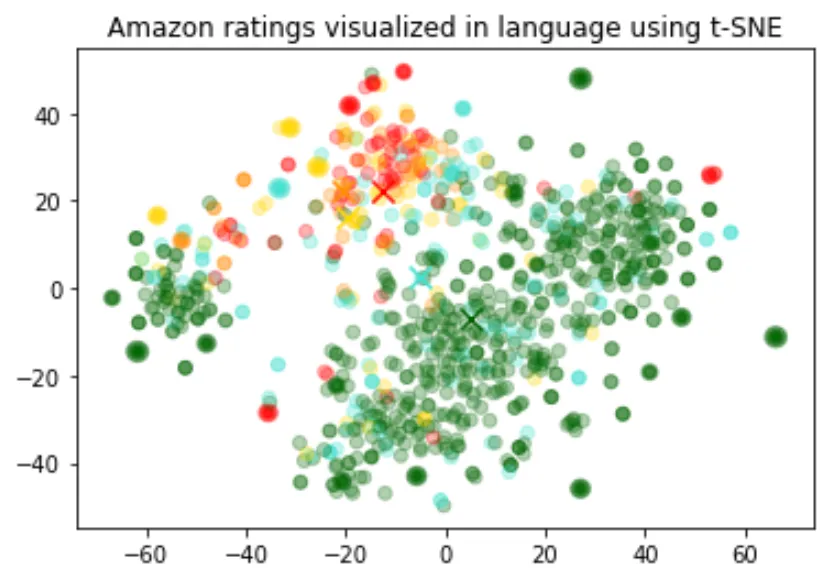
En la visualización se distinguen aproximadamente 3 grupos, uno de los cuales contiene principalmente reseñas negativas.
1
2
3
4
5
6
7
8
9
10
11
12
13
14
15
16
17
18
19
20
21
22
23
24from ast import literal_eval
import numpy as np
import pandas as pd
from sklearn.manifold import TSNE
import matplotlib.pyplot as plt
import matplotlib

df = pd.read_csv("output/embedded_1k_reviews.csv")
matrix = np.array(df.ada_embedding.apply(literal_eval).to_list())

# Create a t-SNE model and transform the data
tsne = TSNE(
    n_components=2, perplexity=15, random_state=42, init="random", learning_rate=200
)
vis_dims = tsne.fit_transform(matrix)

colors = ["red", "darkorange", "gold", "turquoise", "darkgreen"]
x = [x for x, y in vis_dims]
y = [y for x, y in vis_dims]
color_indices = df.Score.values - 1

colormap = matplotlib.colors.ListedColormap(colors)
plt.scatter(x, y, c=color_indices, cmap=colormap, alpha=0.3)
plt.title("Amazon ratings visualized in language using t-SNE")En un modelo de aprendizaje automático, puedes usar embeddings como método general para codificar características de texto libre. Incorporar embeddings mejora el rendimiento de cualquier modelo de aprendizaje automático si algunas de sus entradas relevantes son de texto libre. También puedes usar un embedding para codificar características categóricas en un modelo de aprendizaje automático. Esto resulta especialmente útil cuando las categorías son numerosas y sus nombres tienen significado propio, como ocurre con los puestos de trabajo. Para esta tarea, los embeddings de similitud suelen dar mejores resultados que los de búsqueda.
Observamos que la representación mediante embeddings suele concentrar una gran cantidad de información. Por ejemplo, reducir la dimensionalidad de las entradas mediante SVD o PCA, incluso en tan solo un 10 %, suele empeorar el rendimiento en tareas específicas posteriores.
Este código divide los datos en un conjunto de entrenamiento y otro de prueba. Usaremos ambos en los dos casos de uso siguientes: regresión y clasificación.
1
2
3
4
5from sklearn.model_selection import train_test_split

X_train, X_test, y_train, y_test = train_test_split(
    list(df.ada_embedding.values), df.Score, test_size=0.2, random_state=42
)
Regresión con las características de los embeddings
Los embeddings ofrecen una forma sencilla de predecir un valor numérico. En este ejemplo, predecimos cuántas estrellas dio el autor de una reseña a partir del texto que escribió. Como los embeddings contienen abundante información semántica, la predicción es razonablemente precisa incluso con muy pocas reseñas.
Tratamos la calificación como una variable continua entre 1 y 5 y permitimos que el algoritmo prediga cualquier valor de punto flotante. El algoritmo de aprendizaje automático minimiza la distancia entre el valor predicho y la calificación real. El error absoluto medio es de 0,39, lo que significa que, en promedio, la predicción difiere de la calificación real en menos de media estrella.
1
2
3
4
5from sklearn.ensemble import RandomForestRegressor

rfr = RandomForestRegressor(n_estimators=100)
rfr.fit(X_train, y_train)
preds = rfr.predict(X_test)Esta vez, en lugar de pedir al algoritmo que prediga cualquier valor entre 1 y 5, intentaremos identificar el número exacto de estrellas de cada reseña asignándola a una de cinco categorías, de 1 a 5 estrellas.
Una vez entrenado, el modelo predice mucho mejor las calificaciones de 1 y 5 estrellas que las de las reseñas con más matices (de 2 a 4 estrellas), probablemente porque en los extremos las opiniones se expresan con mayor intensidad.
1
2
3
4
5
6from sklearn.ensemble import RandomForestClassifier
from sklearn.metrics import classification_report, accuracy_score

clf = RandomForestClassifier(n_estimators=100)
clf.fit(X_train, y_train)
preds = clf.predict(X_test)Podemos usar embeddings para la clasificación sin ejemplos, sin necesidad de datos de entrenamiento etiquetados. Para cada clase, generamos un embedding de su nombre o de una breve descripción. Para clasificar un texto nuevo sin ejemplos, comparamos su embedding con los embeddings de todas las clases y elegimos como predicción la clase con mayor similitud.
1
2
3
4
5
6
7
8
9
10
11
12
13
14
15
16
17
18
19
20
21import OpenAI from "openai";

const client = new OpenAI();
const labels = ["negative", "positive"];

const { data } = await client.embeddings.create({
  model: "text-embedding-3-small",
  input: [...labels, "The coffee arrived quickly and tastes great."],
});

const review = data.at(-1).embedding;
const similarity = (embedding) => {
  const dotProduct = embedding.reduce(
    (total, value, index) => total + value * review[index],
    0
  );
  return dotProduct / (Math.hypot(...embedding) * Math.hypot(...review));
};

const [negative, positive] = data.map(({ embedding }) => similarity(embedding));
console.log(positive > negative ? "positive" : "negative");
1
2
3
4
5
6
7
8
9
10
11
12
13
14
15
16
17
18df = df[df.Score != 3]
df["sentiment"] = df.Score.replace(
{1: "negative", 2: "negative", 4: "positive", 5: "positive"}
)
labels = ["negative", "positive"]
label_embeddings = [get_embedding(label, model=model) for label in labels]
def label_score(review_embedding, label_embeddings):
return cosine_similarity(review_embedding, label_embeddings[1]) - cosine_similarity(
review_embedding, label_embeddings[0]
)
prediction = (
"positive" if label_score(get_embedding("Sample Review", model=model), label_embeddings) > 0 else "negative"
)1
2
3
4
5
6
7
8
9
10
11
12
13
14
15
16
17
18
19
20
21
22
23
24
25
26
27
28
29
30
31
32
33
34
35
36
37
38
39
40
41
42
43
44
45
46
47
48
49
50
51
52
53
54
55
56
57
58
59import (
"context"
"fmt"
"log"
"math"
"github.com/openai/openai-go/v3"
)
func main() {
if err := run(); err != nil {
log.Fatal(err)
}
}
func run() error {
client := openai.NewClient()
ctx := context.Background()
negative, err := embedding(ctx, &client, "negative")
if err != nil {
return err
}
positive, err := embedding(ctx, &client, "positive")
if err != nil {
return err
}
review, err := embedding(ctx, &client, "Sample Review")
if err != nil {
return err
}
score := cosineSimilarity(review, positive) - cosineSimilarity(review, negative)
prediction := "negative"
if score > 0 {
prediction = "positive"
}
fmt.Println(prediction)
return nil
}
func embedding(ctx context.Context, client *openai.Client, text string) ([]float64, error) {
response, err := client.Embeddings.New(ctx, openai.EmbeddingNewParams{
Model: openai.EmbeddingModelTextEmbedding3Small,
Input: openai.EmbeddingNewParamsInputUnion{OfString: openai.String(text)},
})
if err != nil {
return nil, err
}
return response.Data[0].Embedding, nil
}
func cosineSimilarity(a, b []float64) float64 {
var dot, left, right float64
for i := range a {
dot += a[i] * b[i]
left += a[i] * a[i]
right += b[i] * b[i]
}
return dot / math.Sqrt(left*right)
}1
2
3
4
5
6
7
8
9
10
11
12
13
14
15
16
17
18
19import com.openai.client.OpenAIClient;
import com.openai.client.okhttp.OpenAIOkHttpClient;
import com.openai.models.embeddings.EmbeddingCreateParams;
import java.util.List;
var embeddings =
client
.embeddings()
.create(
EmbeddingCreateParams.builder()
.model("text-embedding-3-small")
.inputOfArrayOfStrings(List.of("negative", "positive", "Sample Review"))
.build())
.data();
List<Float> review = embeddings.get(2).embedding();
double negative = cosineSimilarity(review, embeddings.get(0).embedding());
double positive = cosineSimilarity(review, embeddings.get(1).embedding());
System.out.println(positive > negative ? "positive" : "negative");1
2
3
4
5
6
7
8
9
10
11
12
13
14
15
16
17
18
19
20
21
22
23
24
25
26
27
28
29using OpenAI.Embeddings;
string key = Environment.GetEnvironmentVariable("OPENAI_API_KEY")!;
string model = "text-embedding-3-small";
EmbeddingClient client = new(model, key);
float[] negative = await EmbedAsync(client, "negative");
float[] positive = await EmbedAsync(client, "positive");
float[] review = await EmbedAsync(client, "Sample Review");
double score = CosineSimilarity(review, positive) - CosineSimilarity(review, negative);
Console.WriteLine(score > 0 ? "positive" : "negative");
static async Task<float[]> EmbedAsync(EmbeddingClient client, string text)
{
OpenAIEmbedding result = await client.GenerateEmbeddingAsync(text);
return result.ToFloats().ToArray();
}
static double CosineSimilarity(float[] left, float[] right)
{
double dot = 0, leftNorm = 0, rightNorm = 0;
for (int i = 0; i < left.Length; i++)
{
dot += (double)left[i] * right[i];
leftNorm += (double)left[i] * left[i];
rightNorm += (double)right[i] * right[i];
}
return dot / Math.Sqrt(leftNorm * rightNorm);
}1
2
3
4
5
6
7
8
9
10
11
12
13
14
15
16
17
18
19
20
21
22require "openai"
client = OpenAI::Client.new
labels = ["negative", "positive"]
response = client.embeddings.create(
model: "text-embedding-3-small",
input: labels + ["The coffee arrived quickly and tastes great."]
)
review = response.data.fetch(-1).embedding
similarity = lambda do |embedding|
dot_product = embedding.zip(review).sum { |value, review_value| value * review_value }
magnitude = Math.sqrt(embedding.sum { |value| value**2 })
review_magnitude = Math.sqrt(review.sum { |value| value**2 })
dot_product / (magnitude * review_magnitude)
end
negative, positive = response.data.first(2).map do |embedding|
similarity.call(embedding.embedding)
end
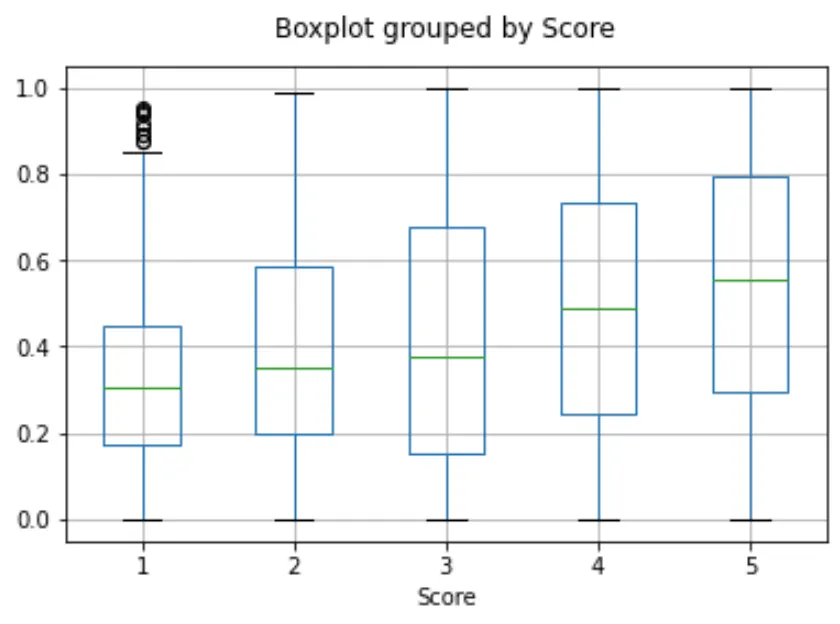
puts((positive > negative) ? "positive" : "negative")Podemos obtener el embedding de un usuario calculando el promedio de los embeddings de todas sus reseñas. De manera similar, podemos obtener el embedding de un producto a partir del promedio de los embeddings de todas las reseñas sobre ese producto. Para mostrar la utilidad de este método, usamos un subconjunto de 50 000 reseñas que nos permite incluir más reseñas por usuario y por producto.
Evaluamos la utilidad de estos embeddings en un conjunto de prueba independiente. Allí graficamos la similitud entre el embedding del usuario y el del producto en función de la calificación. Con este método podemos predecir si al usuario le gustará el producto incluso antes de que lo reciba, con mayor acierto que si lo hiciéramos al azar.
user_embeddings = df.groupby("UserId").ada_embedding.apply(np.mean)
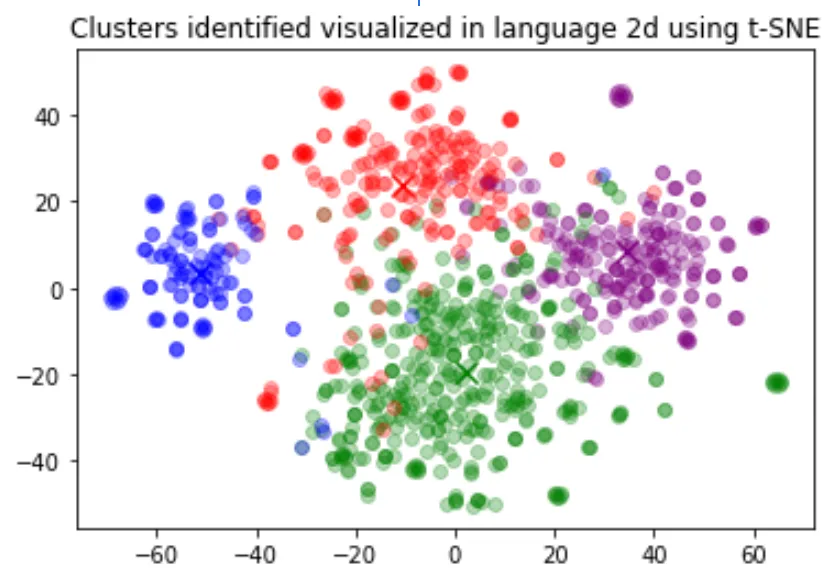
prod_embeddings = df.groupby("ProductId").ada_embedding.apply(np.mean)El agrupamiento permite interpretar grandes volúmenes de datos de texto. Los embeddings son útiles para esta tarea porque representan el significado de cada texto mediante un vector. Así, el agrupamiento permite descubrir grupos ocultos en el conjunto de datos sin supervisión.
En este ejemplo identificamos cuatro grupos distintos: uno de reseñas sobre alimento para perros, uno de reseñas negativas y dos de reseñas positivas.
1
2
3
4
5
6
7
8
9import numpy as np
from sklearn.cluster import KMeans

matrix = np.vstack(df.ada_embedding.values)
n_clusters = 4

kmeans = KMeans(n_clusters=n_clusters, init="k-means++", random_state=42)
kmeans.fit(matrix)
df["Cluster"] = kmeans.labels_
Preguntas frecuentes
¿Cómo puedo saber cuántos tokens tiene una cadena antes de generar su embedding?
En Python, puedes dividir una cadena en tokens con el tokenizador de OpenAI tiktoken.
Código de ejemplo:
1
2
3
4
5
6
7
8
9
10
11import tiktoken


def num_tokens_from_string(string: str, encoding_name: str) -> int:
    """Returns the number of tokens in a text string."""
    encoding = tiktoken.get_encoding(encoding_name)
    num_tokens = len(encoding.encode(string))
    return num_tokens


num_tokens_from_string("tiktoken is great!", "cl100k_base")
Para los modelos de embeddings de tercera generación, como text-embedding-3-small, usa la codificación cl100k_base.
Encontrarás más detalles y ejemplos de código en la guía de OpenAI Cookbook sobre cómo contar tokens con tiktoken.
¿Cómo puedo recuperar rápidamente los K vectores de embeddings más cercanos?
Para buscar rápidamente entre muchos vectores, recomendamos usar una base de datos vectorial. Puedes encontrar ejemplos de cómo trabajar con bases de datos vectoriales y la API de OpenAI en nuestro Cookbook en GitHub.
¿Qué función de distancia debo usar?
Recomendamos la similitud del coseno. Por lo general, la elección de la función de distancia influye poco en los resultados.
Los embeddings de OpenAI están normalizados para que su norma sea igual a 1. Esto tiene dos consecuencias:
- Puedes calcular la similitud del coseno un poco más rápido con solo un producto escalar.
- La similitud del coseno y la distancia euclidiana producen exactamente el mismo orden de resultados.
¿Puedo compartir mis embeddings en línea?
Sí. Como cliente, eres titular de los datos que ingresas en nuestros modelos y de los resultados que obtienes, incluidos los embeddings. Es tu responsabilidad asegurarte de que el contenido que envíes a nuestra API cumpla con todas las leyes aplicables y con nuestros Términos de uso.
¿Los modelos de embeddings V3 conocen los acontecimientos recientes?
No. Los modelos text-embedding-3-large y text-embedding-3-small desconocen los acontecimientos posteriores a septiembre de 2021. Por lo general, esta limitación tiene menos impacto que en los modelos de generación de texto, aunque en algunos casos poco comunes puede reducir el rendimiento.