
text-embedding-3-small and text-embedding-3-large, our newest and most performant embedding models, are now available. They feature lower costs, higher multilingual performance, and new parameters to control the overall size.O que são embeddings?
Os embeddings de texto da OpenAI medem o quanto dois textos se relacionam. Entre os usos mais comuns dos embeddings estão:
- Busca (os resultados são ordenados por relevância para a consulta)
- Agrupamento (os textos são agrupados por similaridade)
- Recomendações (são recomendados itens cujos textos se relacionam)
- Detecção de anomalias (são identificados itens atípicos com pouca relação com os demais)
- Medição da diversidade (são analisadas as distribuições de similaridade)
- Classificação (cada texto é classificado de acordo com o rótulo mais semelhante a ele)
Um embedding é um vetor (lista) de números de ponto flutuante. A distância entre dois vetores mede o grau de relação entre eles. Distâncias pequenas sugerem uma relação forte, e distâncias grandes sugerem uma relação fraca.
Consulte nossa página de preços para saber quanto custa gerar embeddings. O valor de cada solicitação depende do número de tokens na entrada.
Como obter embeddings
Para obter um embedding, envie seu texto ao endpoint da API de embeddings junto com o nome do modelo de embeddings (por exemplo, text-embedding-3-small).
1
2
3
4
5
6
7
8
9
10import OpenAI from "openai";
const openai = new OpenAI();

const embedding = await openai.embeddings.create({
  model: "text-embedding-3-small",
  input: "Your text string goes here",
  encoding_format: "float",
});

console.log(embedding);
1
2
3
4
5
6
7
8
9from openai import OpenAI
client = OpenAI()
response = client.embeddings.create(
input="Your text string goes here", model="text-embedding-3-small"
)
print(response.data[0].embedding)1
2
3
4
5
6
7
8
9
10
11
12
13
14
15
16
17
18
19
20
21
22
23
24package main
import (
"context"
"fmt"
"github.com/openai/openai-go/v3"
)
func main() {
client := openai.NewClient()
embedding, err := client.Embeddings.New(context.Background(), openai.EmbeddingNewParams{
Model: openai.EmbeddingModelTextEmbedding3Small,
Input: openai.EmbeddingNewParamsInputUnion{
OfString: openai.String("Your text string goes here."),
},
})
if err != nil {
panic(err)
}
fmt.Println(len(embedding.Data[0].Embedding))
}1
2
3
4
5
6
7
8
9
10
11
12
13
14import com.openai.client.OpenAIClient;
import com.openai.client.okhttp.OpenAIOkHttpClient;
import com.openai.models.embeddings.EmbeddingCreateParams;
var embedding =
client
.embeddings()
.create(
EmbeddingCreateParams.builder()
.model("text-embedding-3-small")
.input("The food was delicious and the waiter...")
.build());
System.out.println(embedding.data().get(0).embedding());1
2
3
4
5
6
7
8
9
10
11using OpenAI.Embeddings;
string key = Environment.GetEnvironmentVariable("OPENAI_API_KEY")!;
string model = "text-embedding-3-small";
EmbeddingClient client = new(model, key);
OpenAIEmbedding embedding = await client.GenerateEmbeddingAsync(
"The food was delicious and the waiter was friendly."
);
Console.WriteLine($"Dimensions: {embedding.ToFloats().Length}");1
2
3
4
5
6
7
8
9
10require "openai"
client = OpenAI::Client.new
response = client.embeddings.create(
model: "text-embedding-3-small",
input: "The food was delicious and the waiter..."
)
puts(response.data.fetch(0).embedding)1
2
3
4
5
6
7curl https://api.openai.com/v1/embeddings \
-H "Content-Type: application/json" \
-H "Authorization: Bearer $OPENAI_API_KEY" \
-d '{
"input": "Your text string goes here",
"model": "text-embedding-3-small"
}'A resposta contém o vetor de embedding (uma lista de números de ponto flutuante) e alguns metadados adicionais. Você pode extrair o vetor, salvá-lo em um banco de dados vetorial e usá-lo em diversas aplicações.
123456789101112131415161718{
  "object": "list",
  "data": [
    {
      "object": "embedding",
      "index": 0,
      "embedding": [
        -0.006929283495992422, -0.005336422007530928, -4.547132266452536e-5,
        -0.024047505110502243
      ]
    }
  ],
  "model": "text-embedding-3-small",
  "usage": {
    "prompt_tokens": 5,
    "total_tokens": 5
  }
}
Por padrão, o vetor de embedding tem 1536 dimensões no modelo text-embedding-3-small ou 3072 no modelo text-embedding-3-large. Para reduzir o número de dimensões do embedding sem que ele perca a capacidade de representar conceitos, informe o parâmetro dimensions. Saiba mais sobre as dimensões dos embeddings na seção sobre casos de uso.
Modelos de embeddings
A OpenAI oferece dois modelos avançados de embeddings de terceira geração (identificados por -3 no ID do modelo). Para mais detalhes, leia o anúncio de lançamento dos modelos de embeddings v3.
O uso é cobrado por token de entrada. A tabela mostra quantas páginas de texto é possível processar por dólar americano, considerando cerca de 800 tokens por página.
| Modelo | Páginas por dólar (aprox.) | Desempenho na avaliação MTEB | Entrada máxima |
|---|---|---|---|
| text-embedding-3-small | 62.500 | 62,3% | 8192 |
| text-embedding-3-large | 9.615 | 64,6% | 8192 |
| text-embedding-ada-002 | 12.500 | 61,0% | 8192 |
Casos de uso
Os exemplos a seguir ilustram alguns casos de uso com o conjunto de dados de avaliações de produtos alimentícios da Amazon.
Como obter os embeddings
O conjunto de dados contém 568.454 avaliações de produtos alimentícios publicadas por usuários da Amazon até outubro de 2012. Para os exemplos, usamos as 1.000 avaliações mais recentes. As avaliações estão em inglês e tendem a ser positivas ou negativas. Cada avaliação contém os campos ProductId, UserId e Score, além do título (Summary) e do texto da avaliação (Text). Por exemplo:
| ID do produto | ID do usuário | Nota | Resumo | Texto |
|---|---|---|---|---|
| B001E4KFG0 | A3SGXH7AUHU8GW | 5 | Good Quality Dog Food | I have bought several of the Vitality canned… |
| B00813GRG4 | A1D87F6ZCVE5NK | 1 | Not as Advertised | Product arrived labeled as Jumbo Salted Peanut… |
No exemplo a seguir, reunimos o resumo e o texto da avaliação em um único texto. O modelo codifica esse texto e gera um único embedding vetorial.
1
2
3
4
5
6
7
8
9
10
11
12
13
14
15
16
17
18
19
20
21import { mkdir, writeFile } from "node:fs/promises";
import OpenAI from "openai";

const client = new OpenAI();
const reviews = ["A rich cup of coffee.", "A bright herbal tea."];

const response = await client.embeddings.create({
  model: "text-embedding-3-small",
  input: reviews.map((review) => review.replaceAll("\n", " ")),
});

const csvField = (value) => `"${value.replaceAll('"', '""')}"`;
const rows = response.data.map(({ embedding }, index) =>
  [csvField(reviews[index]), csvField(JSON.stringify(embedding))].join(",")
);

await mkdir("output", { recursive: true });
await writeFile(
  "output/embedded_1k_reviews.csv",
  ["combined,ada_embedding", ...rows].join("\n") + "\n"
);
1
2
3
4
5
6
7
8
9
10
11
12
13
14
15
16
17from pathlib import Path
from openai import OpenAI
client = OpenAI()
def get_embedding(text, model="text-embedding-3-small"):
text = text.replace("\n", " ")
return client.embeddings.create(input=[text], model=model).data[0].embedding
df["ada_embedding"] = df.combined.apply(
lambda x: get_embedding(x, model="text-embedding-3-small")
)
Path("output").mkdir(exist_ok=True)
df.to_csv("output/embedded_1k_reviews.csv", index=False)1
2
3
4
5
6
7
8
9
10
11
12
13
14
15
16
17
18
19
20
21
22
23
24
25
26
27
28
29
30
31
32
33
34
35
36
37
38
39
40
41
42
43
44
45
46
47
48
49
50
51
52
53
54
55
56
57
58
59
60
61
62
63
64
65
66
67
68import (
"context"
"encoding/csv"
"encoding/json"
"fmt"
"log"
"os"
"strings"
"github.com/openai/openai-go/v3"
)
func main() {
if err := run(); err != nil {
log.Fatal(err)
}
}
func run() error {
client := openai.NewClient()
ctx := context.Background()
reviews := []string{"A rich cup of coffee.", "A bright herbal tea."}
if err := os.MkdirAll("output", 0755); err != nil {
return err
}
file, err := os.Create("output/embedded_1k_reviews.csv")
if err != nil {
return err
}
defer file.Close()
writer := csv.NewWriter(file)
if err := writer.Write([]string{"combined", "ada_embedding"}); err != nil {
return err
}
for _, review := range reviews {
vector, err := embedding(ctx, &client, strings.ReplaceAll(review, "\n", " "))
if err != nil {
return err
}
encoded, err := json.Marshal(vector)
if err != nil {
return err
}
if err := writer.Write([]string{review, string(encoded)}); err != nil {
return err
}
}
writer.Flush()
if err := writer.Error(); err != nil {
return err
}
if err := file.Close(); err != nil {
return err
}
fmt.Println("Saved output/embedded_1k_reviews.csv")
return nil
}
func embedding(ctx context.Context, client *openai.Client, text string) ([]float64, error) {
response, err := client.Embeddings.New(ctx, openai.EmbeddingNewParams{
Model: openai.EmbeddingModelTextEmbedding3Small,
Input: openai.EmbeddingNewParamsInputUnion{OfString: openai.String(text)},
})
if err != nil {
return nil, err
}
return response.Data[0].Embedding, nil
}1
2
3
4
5
6
7
8
9
10
11
12
13
14
15
16
17
18
19
20
21
22
23
24
25
26
27
28
29
30
31
32
33import com.openai.client.OpenAIClient;
import com.openai.client.okhttp.OpenAIOkHttpClient;
import com.openai.models.embeddings.EmbeddingCreateParams;
import java.io.IOException;
import java.nio.file.Files;
import java.nio.file.Path;
import java.util.List;
static String csvField(String value) {
return "\"" + value.replace("\"", "\"\"") + "\"";
}
List<String> reviews = List.of("A rich cup of coffee.", "A bright herbal tea.");
Path output = Path.of("output", "embedded_1k_reviews.csv");
Files.createDirectories(output.getParent());
try (var writer = Files.newBufferedWriter(output)) {
writer.write("combined,ada_embedding\n");
for (String review : reviews) {
var embedding =
client
.embeddings()
.create(
EmbeddingCreateParams.builder()
.model("text-embedding-3-small")
.inputOfArrayOfStrings(List.of(review.replace("\n", " ")))
.build())
.data()
.get(0)
.embedding();
writer.write(csvField(review) + "," + csvField(embedding.toString()) + "\n");
}
}
System.out.println(output);1
2
3
4
5
6
7
8
9
10
11
12
13
14
15
16
17
18
19
20
21
22
23
24
25
26using System.Text.Json;
using OpenAI.Embeddings;
string key = Environment.GetEnvironmentVariable("OPENAI_API_KEY")!;
string model = "text-embedding-3-small";
EmbeddingClient client = new(model, key);
string[] reviews = ["A rich cup of coffee.", "A bright herbal tea."];
Directory.CreateDirectory("output");
using StreamWriter writer = new("output/embedded_1k_reviews.csv");
await writer.WriteLineAsync("combined,ada_embedding");
foreach (string review in reviews)
{
float[] vector = await EmbedAsync(client, review.Replace("\n", " ", StringComparison.Ordinal));
string encoded = JsonSerializer.Serialize(vector);
await writer.WriteLineAsync($"{CsvField(review)},{CsvField(encoded)}");
}
Console.WriteLine("Saved output/embedded_1k_reviews.csv");
static async Task<float[]> EmbedAsync(EmbeddingClient client, string text)
{
OpenAIEmbedding result = await client.GenerateEmbeddingAsync(text);
return result.ToFloats().ToArray();
}
static string CsvField(string value) => "\"" + value.Replace("\"", "\"\"", StringComparison.Ordinal) + "\"";1
2
3
4
5
6
7
8
9
10
11
12
13
14
15
16
17
18
19
20require "csv"
require "fileutils"
require "json"
require "openai"
client = OpenAI::Client.new
reviews = ["A rich cup of coffee.", "A bright herbal tea."]
response = client.embeddings.create(
model: "text-embedding-3-small",
input: reviews.map { |review| review.tr("\n", " ") }
)
FileUtils.mkdir_p("output")
CSV.open("output/embedded_1k_reviews.csv", "w") do |csv|
csv << ["combined", "ada_embedding"]
response.data.each do |embedding|
csv << [reviews.fetch(embedding.index), JSON.generate(embedding.embedding)]
end
endPara carregar os dados de um arquivo salvo, execute o código a seguir.
1
2
3
4
5from ast import literal_eval
import pandas as pd

df = pd.read_csv("output/embedded_1k_reviews.csv")
df["ada_embedding"] = df.ada_embedding.apply(literal_eval).apply(np.array)Usar embeddings maiores, por exemplo, ao armazená-los em um repositório vetorial para recuperá-los depois, geralmente custa mais e exige mais processamento, memória e espaço de armazenamento do que usar embeddings menores.
Treinamos nossos dois novos modelos de embeddings com uma técnica que permite equilibrar desempenho e custo. Ao informar o parâmetro dimensions da API, você pode encurtar os embeddings (ou seja, remover alguns números do fim da sequência) sem que eles percam a capacidade de representar conceitos. Por exemplo, na avaliação MTEB, um embedding do modelo text-embedding-3-large reduzido a 256 dimensões ainda supera um embedding do modelo text-embedding-ada-002 com todas as suas 1.536 dimensões. Saiba mais sobre como a mudança no número de dimensões afeta o desempenho na publicação sobre o lançamento dos modelos de embeddings v3.
Em geral, recomendamos usar o parâmetro dimensions ao criar o embedding. Em alguns casos, pode ser necessário alterar o número de dimensões depois de gerar o embedding. Se fizer essa alteração manualmente, normalize o vetor resultante como mostra o exemplo a seguir.
1
2
3
4
5
6
7
8
9
10
11
12
13
14
15
16
17import OpenAI from "openai";

const client = new OpenAI();

const response = await client.embeddings.create({
  model: "text-embedding-3-small",
  input: "Testing 123",
  encoding_format: "float",
});

const shortened = response.data[0].embedding.slice(0, 256);
const magnitude = Math.hypot(...shortened);
const normalized = shortened.map((value) =>
  magnitude === 0 ? 0 : value / magnitude
);

console.log(normalized);
1
2
3
4
5
6
7
8
9
10
11
12
13
14
15
16
17
18
19
20
21
22
23
24
25
26from openai import OpenAI
import numpy as np
client = OpenAI()
def normalize_l2(x):
x = np.array(x)
if x.ndim == 1:
norm = np.linalg.norm(x)
if norm == 0:
return x
return x / norm
else:
norm = np.linalg.norm(x, 2, axis=1, keepdims=True)
return np.where(norm == 0, x, x / norm)
response = client.embeddings.create(
model="text-embedding-3-small", input="Testing 123", encoding_format="float"
)
cut_dim = response.data[0].embedding[:256]
norm_dim = normalize_l2(cut_dim)
print(norm_dim)1
2
3
4
5
6
7
8
9
10
11
12
13
14
15
16
17
18
19
20
21
22
23import com.openai.client.OpenAIClient;
import com.openai.client.okhttp.OpenAIOkHttpClient;
import com.openai.models.embeddings.EmbeddingCreateParams;
import java.util.List;
private static List<Double> normalizeL2(List<Float> embedding) {
double norm =
Math.sqrt(embedding.stream().mapToDouble(value -> value.doubleValue() * value).sum());
return embedding.stream().map(value -> norm == 0 ? 0.0 : value / norm).toList();
}
var embedding =
client
.embeddings()
.create(
EmbeddingCreateParams.builder()
.model("text-embedding-3-small")
.input("Testing 123")
.encodingFormat(EmbeddingCreateParams.EncodingFormat.FLOAT)
.build());
List<Float> shortened = embedding.data().get(0).embedding().subList(0, 256);
System.out.println(normalizeL2(shortened));1
2
3
4
5
6
7
8
9
10
11
12
13
14
15
16using OpenAI.Embeddings;
string key = Environment.GetEnvironmentVariable("OPENAI_API_KEY")!;
string model = "text-embedding-3-small";
EmbeddingClient client = new(model, key);
OpenAIEmbedding embedding = await client.GenerateEmbeddingAsync("Testing 123");
float[] shortened = embedding.ToFloats().Span[..256].ToArray();
double magnitude = Math.Sqrt(shortened.Sum(value => (double)value * value));
double[] normalized =
magnitude == 0
? shortened.Select(value => (double)value).ToArray()
: shortened.Select(value => value / magnitude).ToArray();
Console.WriteLine(System.Text.Json.JsonSerializer.Serialize(normalized));1
2
3
4
5
6
7
8
9
10
11
12
13
14
15require "openai"
client = OpenAI::Client.new
response = client.embeddings.create(
model: "text-embedding-3-small",
input: "Testing 123",
encoding_format: :float
)
shortened = response.data.fetch(0).embedding.first(256)
magnitude = Math.sqrt(shortened.sum { |value| value**2 })
normalized = shortened.map { |value| magnitude.zero? ? 0 : value / magnitude }
puts(normalized)A possibilidade de alterar o número de dimensões dinamicamente dá mais flexibilidade ao uso dos embeddings. Por exemplo, mesmo que seu repositório vetorial só aceite embeddings de até 1.024 dimensões, você pode usar nosso melhor modelo de embeddings, o text-embedding-3-large. Basta informar o valor 1024 no parâmetro dimensions da API. Assim, o embedding passa de 3.072 para 1.024 dimensões, com alguma perda de precisão em troca de um vetor menor.
É comum que os dados de treinamento do modelo não contenham informações importantes para responder à pergunta de um usuário. Uma forma de resolver isso, como mostra o exemplo a seguir, é incluir informações adicionais na janela de contexto do modelo. Essa abordagem funciona em muitos casos, mas aumenta o custo com tokens. Neste notebook, examinamos as vantagens e desvantagens dessa abordagem em relação à busca baseada em embeddings.
1
2
3
4
5
6
7
8
9
10
11
12
13
14
15
16
17
18
19
20
21
22
23
24
25import OpenAI from "openai";

const client = new OpenAI();
const article =
  "At the 2022 Winter Olympics, Great Britain won women's curling and Sweden won men's curling.";
const question = `Use the article below to answer the question. If the answer cannot be found, say "I don't know."

Article:
${article}

Question: Which athletes won the gold medal in curling at the 2022 Winter Olympics?`;

const response = await client.chat.completions.create({
  model: "gpt-4.1-mini",
  messages: [
    {
      role: "system",
      content: "You answer questions about the 2022 Winter Olympics.",
    },
    { role: "user", content: question },
  ],
  temperature: 0,
});

console.log(response.choices[0].message.content);
1
2
3
4
5
6
7
8
9
10
11
12
13
14
15
16
17
18
19
20
21
22query = f"""Use the below article on the 2022 Winter Olympics to answer the subsequent question. If the answer cannot be found, write "I don't know."
Article:
\"\"\"
{wikipedia_article_on_curling}
\"\"\"
Question: Which athletes won the gold medal in curling at the 2022 Winter Olympics?"""
response = client.chat.completions.create(
messages=[
{
"role": "system",
"content": "You answer questions about the 2022 Winter Olympics.",
},
{"role": "user", "content": query},
],
model=GPT_MODEL,
temperature=0,
)
print(response.choices[0].message.content)1
2
3
4
5
6
7
8
9
10
11
12
13
14
15
16
17
18
19
20
21
22
23
24
25
26
27import (
"context"
"fmt"
"log"
"github.com/openai/openai-go/v3"
)
func main() {
if err := run(); err != nil {
log.Fatal(err)
}
}
func run() error {
client := openai.NewClient()
completion, err := client.Chat.Completions.New(context.Background(), openai.ChatCompletionNewParams{
Model: "gpt-4.1-mini", Temperature: openai.Float(0), Messages: []openai.ChatCompletionMessageParamUnion{
openai.SystemMessage("You answer questions about the 2022 Winter Olympics."),
openai.UserMessage("Use the article to answer the question. If the answer cannot be found, write \"I don't know.\"\n\nArticle: At the 2022 Winter Olympics, Great Britain won women's curling and Sweden won men's curling.\n\nQuestion: Which athletes won the gold medal in curling at the 2022 Winter Olympics?")},
})
if err != nil {
return err
}
fmt.Println(completion.Choices[0].Message.Content)
return nil
}1
2
3
4
5
6
7
8
9
10
11
12
13
14
15
16
17
18
19
20
21
22
23
24import com.openai.client.OpenAIClient;
import com.openai.client.okhttp.OpenAIOkHttpClient;
import com.openai.models.chat.completions.ChatCompletionCreateParams;
String article =
"At the 2022 Winter Olympics, Great Britain won women's curling and Sweden won men's curling.";
String question =
"Use the below article on the 2022 Winter Olympics to answer the subsequent question. "
+ "If the answer cannot be found, write \"I don't know.\"\n\n"
+ "Article:\n"
+ article
+ "\n\nQuestion: Which athletes won the gold medal in curling at the 2022 Winter Olympics?";
ChatCompletionCreateParams params =
ChatCompletionCreateParams.builder()
.model("gpt-4.1-mini")
.addSystemMessage("You answer questions about the 2022 Winter Olympics.")
.addUserMessage(question)
.temperature(0)
.build();
client.chat().completions().create(params).choices().stream()
.flatMap(choice -> choice.message().content().stream())
.forEach(System.out::println);1
2
3
4
5
6
7
8
9
10
11
12using OpenAI.Chat;
string key = Environment.GetEnvironmentVariable("OPENAI_API_KEY")!;
string model = "gpt-4.1-mini";
ChatClient client = new(model, key);
string article = "At the 2022 Winter Olympics, Great Britain won women's curling and Sweden won men's curling.";
string query = $"Use the article to answer the question. If the answer cannot be found, write I don't know.\nArticle: {article}\nQuestion: Which athletes won the gold medal in curling at the 2022 Winter Olympics?";
ChatCompletion result = await client.CompleteChatAsync(
[new SystemChatMessage("You answer questions about the 2022 Winter Olympics."), new UserChatMessage(query)],
new ChatCompletionOptions { Temperature = 0 });
Console.WriteLine(result.Content[0].Text);1
2
3
4
5
6
7
8
9
10
11
12
13
14
15
16
17
18
19
20
21
22
23
24
25
26
27
28
29require "openai"
client = OpenAI::Client.new
article = "At the 2022 Winter Olympics, Great Britain won women's curling and Sweden won men's curling."
question = <<~QUESTION
Use the article below to answer the question. If the answer cannot be found, say "I don't know."
Article:
#{article}
Question: Which athletes won the gold medal in curling at the 2022 Winter Olympics?
QUESTION
response = client.chat.completions.create(
model: "gpt-4.1-mini",
messages: [
{
role: :system,
content: "You answer questions about the 2022 Winter Olympics."
},
{
role: :user,
content: question
}
],
temperature: 0
)
puts(response.choices.fetch(0).message.content)Para recuperar os documentos mais relevantes, calculamos a similaridade de cosseno entre o vetor de embedding da consulta e o de cada documento. Em seguida, retornamos os documentos com as maiores pontuações.
1
2
3
4
5
6
7
8
9
10
11
12
13
14
15
16
17
18
19
20
21
22
23
24
25
26
27
28
29
30
31
32import OpenAI from "openai";

const client = new OpenAI();
const reviews = [
  "A rich cup of coffee.",
  "Smooth beans in tomato sauce.",
  "Dark chocolate with orange.",
];

const { data } = await client.embeddings.create({
  model: "text-embedding-3-small",
  input: [...reviews, "delicious beans"],
});

const query = data.at(-1).embedding;
const similarity = (embedding) => {
  const dotProduct = embedding.reduce(
    (total, value, index) => total + value * query[index],
    0
  );
  return dotProduct / (Math.hypot(...embedding) * Math.hypot(...query));
};

const results = reviews
  .map((review, index) => ({
    review,
    score: similarity(data[index].embedding),
  }))
  .sort((left, right) => right.score - left.score)
  .slice(0, 3);

console.log(results);
1
2
3
4
5
6
7
8
9
10def search_reviews(df, product_description, n=3, pprint=True):
embedding = get_embedding(product_description, model="text-embedding-3-small")
df["similarities"] = df.ada_embedding.apply(
lambda x: cosine_similarity(x, embedding)
)
res = df.sort_values("similarities", ascending=False).head(n)
return res
res = search_reviews(df, "delicious beans", n=3)1
2
3
4
5
6
7
8
9
10
11
12
13
14
15
16
17
18
19
20
21
22
23
24
25
26
27
28
29
30
31
32
33
34
35
36
37
38
39
40
41
42
43
44
45
46
47
48
49
50
51
52
53
54
55
56
57
58
59
60
61
62
63
64
65
66
67
68
69
70
71
72
73import (
"context"
"fmt"
"log"
"math"
"sort"
"github.com/openai/openai-go/v3"
)
func main() {
if err := run(); err != nil {
log.Fatal(err)
}
}
func run() error {
client := openai.NewClient()
ctx := context.Background()
texts := []string{"A rich cup of coffee.", "Crunchy crackers with sea salt.", "Dark chocolate with orange.", "A bright herbal tea.", "Smooth beans in tomato sauce.", "A mild cheese with herbs.", "Spicy roasted nuts.", "A crisp sparkling water."}
vectors := make([][]float64, len(texts))
for i, text := range texts {
vector, err := embedding(ctx, &client, text)
if err != nil {
return err
}
vectors[i] = vector
}
query, err := embedding(ctx, &client, "delicious beans")
if err != nil {
return err
}
matches := nearest(query, vectors)
for _, match := range matches[:min(3, len(matches))] {
fmt.Printf("%0.3f: %s\n", match.Similarity, texts[match.Index])
}
return nil
}
func embedding(ctx context.Context, client *openai.Client, text string) ([]float64, error) {
response, err := client.Embeddings.New(ctx, openai.EmbeddingNewParams{
Model: openai.EmbeddingModelTextEmbedding3Small,
Input: openai.EmbeddingNewParamsInputUnion{OfString: openai.String(text)},
})
if err != nil {
return nil, err
}
return response.Data[0].Embedding, nil
}
func cosineSimilarity(a, b []float64) float64 {
var dot, left, right float64
for i := range a {
dot += a[i] * b[i]
left += a[i] * a[i]
right += b[i] * b[i]
}
return dot / math.Sqrt(left*right)
}
type match struct {
Index int
Similarity float64
}
func nearest(query []float64, vectors [][]float64) []match {
matches := make([]match, len(vectors))
for i, vector := range vectors {
matches[i] = match{Index: i, Similarity: cosineSimilarity(query, vector)}
}
sort.SliceStable(matches, func(i, j int) bool { return matches[i].Similarity > matches[j].Similarity })
return matches
}1
2
3
4
5
6
7
8
9
10
11
12
13
14
15
16
17
18
19
20
21
22
23
24
25
26
27
28
29
30
31
32
33
34
35
36
37
38
39
40
41
42
43import com.openai.client.OpenAIClient;
import com.openai.client.okhttp.OpenAIOkHttpClient;
import com.openai.models.embeddings.EmbeddingCreateParams;
import java.util.Comparator;
import java.util.List;
import java.util.stream.IntStream;
List<String> reviews =
List.of(
"A rich cup of coffee.",
"Smooth beans in tomato sauce.",
"Dark chocolate with orange.");
var reviewEmbeddings =
client
.embeddings()
.create(
EmbeddingCreateParams.builder()
.model("text-embedding-3-small")
.inputOfArrayOfStrings(reviews)
.build())
.data();
List<Float> query =
client
.embeddings()
.create(
EmbeddingCreateParams.builder()
.model("text-embedding-3-small")
.inputOfArrayOfStrings(List.of("delicious beans"))
.build())
.data()
.get(0)
.embedding();
IntStream.range(0, reviews.size())
.boxed()
.sorted(
Comparator.comparingDouble(
(Integer index) ->
cosineSimilarity(query, reviewEmbeddings.get(index).embedding()))
.reversed())
.limit(3)
.map(reviews::get)
.forEach(System.out::println);1
2
3
4
5
6
7
8
9
10
11
12
13
14
15
16
17
18
19
20
21
22
23
24
25
26
27
28
29
30
31
32
33using OpenAI.Embeddings;
string key = Environment.GetEnvironmentVariable("OPENAI_API_KEY")!;
string model = "text-embedding-3-small";
EmbeddingClient client = new(model, key);
string[] texts = ["A rich cup of coffee.", "Crunchy crackers with sea salt.", "Dark chocolate with orange.", "A bright herbal tea.", "Smooth beans in tomato sauce.", "A mild cheese with herbs.", "Spicy roasted nuts.", "A crisp sparkling water."];
OpenAIEmbeddingCollection batch = await client.GenerateEmbeddingsAsync(texts);
float[][] vectors = batch.Select(item => item.ToFloats().ToArray()).ToArray();
float[] query = await EmbedAsync(client, "delicious beans");
var ranked = vectors.Select((vector, index) => new { Index = index, Similarity = CosineSimilarity(query, vector) }).OrderByDescending(match => match.Similarity);
foreach (var match in ranked.Take(3))
{
Console.WriteLine($"{match.Similarity:F3}: {texts[match.Index]}");
}
static async Task<float[]> EmbedAsync(EmbeddingClient client, string text)
{
OpenAIEmbedding result = await client.GenerateEmbeddingAsync(text);
return result.ToFloats().ToArray();
}
static double CosineSimilarity(float[] left, float[] right)
{
double dot = 0, leftNorm = 0, rightNorm = 0;
for (int i = 0; i < left.Length; i++)
{
dot += (double)left[i] * right[i];
leftNorm += (double)left[i] * left[i];
rightNorm += (double)right[i] * right[i];
}
return dot / Math.Sqrt(leftNorm * rightNorm);
}1
2
3
4
5
6
7
8
9
10
11
12
13
14
15
16
17
18
19
20
21
22
23
24
25
26
27
28
29
30require "openai"
client = OpenAI::Client.new
reviews = [
"A rich cup of coffee.",
"Smooth beans in tomato sauce.",
"Dark chocolate with orange."
]
response = client.embeddings.create(
model: "text-embedding-3-small",
input: reviews + ["delicious beans"]
)
query = response.data.fetch(-1).embedding
similarity = lambda do |embedding|
dot_product = embedding.zip(query).sum { |value, query_value| value * query_value }
magnitude = Math.sqrt(embedding.sum { |value| value**2 })
query_magnitude = Math.sqrt(query.sum { |value| value**2 })
dot_product / (magnitude * query_magnitude)
end
results = reviews.map.with_index do |review, index|
{
review: review,
score: similarity.call(response.data.fetch(index).embedding)
}
end.sort_by { |result| -result.fetch(:score) }.first(3)
puts(results)A busca de código funciona de forma semelhante à busca de texto baseada em embeddings. O exemplo mostra como extrair as funções Python de todos os arquivos Python de um repositório. Em seguida, cada função é indexada com o modelo text-embedding-3-small.
Para buscar código, usamos o mesmo modelo para gerar o embedding da consulta em linguagem natural. Depois, calculamos a similaridade de cosseno entre o embedding da consulta e o de cada função. Os resultados com a maior similaridade de cosseno são os mais relevantes.
1
2
3
4
5
6
7
8
9
10
11
12
13
14
15
16
17
18
19
20
21
22
23
24
25
26
27
28
29
30import OpenAI from "openai";

const client = new OpenAI();
const functions = [
  "function add(a, b) { return a + b; }",
  "function complete(prompt) { return prompt; }",
];

const { data } = await client.embeddings.create({
  model: "text-embedding-3-small",
  input: [...functions, "Completions API tests"],
});

const query = data.at(-1).embedding;
const similarity = (embedding) => {
  const dotProduct = embedding.reduce(
    (total, value, index) => total + value * query[index],
    0
  );
  return dotProduct / (Math.hypot(...embedding) * Math.hypot(...query));
};

const results = functions
  .map((source, index) => ({
    source,
    score: similarity(data[index].embedding),
  }))
  .sort((left, right) => right.score - left.score);

console.log(results);
1
2
3
4
5
6
7
8
9
10
11
12
13
14
15
16df["code_embedding"] = df["code"].apply(
lambda x: get_embedding(x, model="text-embedding-3-small")
)
def search_functions(df, code_query, n=3, pprint=True, n_lines=7):
embedding = get_embedding(code_query, model="text-embedding-3-small")
df["similarities"] = df.code_embedding.apply(
lambda x: cosine_similarity(x, embedding)
)
res = df.sort_values("similarities", ascending=False).head(n)
return res
res = search_functions(df, "Completions API tests", n=3)1
2
3
4
5
6
7
8
9
10
11
12
13
14
15
16
17
18
19
20
21
22
23
24
25
26
27
28
29
30
31
32
33
34
35
36
37
38
39
40
41
42
43
44
45
46
47
48
49
50
51
52
53
54
55
56
57
58
59
60
61
62
63
64
65
66
67
68
69
70
71
72
73import (
"context"
"fmt"
"log"
"math"
"sort"
"github.com/openai/openai-go/v3"
)
func main() {
if err := run(); err != nil {
log.Fatal(err)
}
}
func run() error {
client := openai.NewClient()
ctx := context.Background()
texts := []string{"def add(a, b): return a + b", "def complete(prompt): return prompt"}
vectors := make([][]float64, len(texts))
for i, text := range texts {
vector, err := embedding(ctx, &client, text)
if err != nil {
return err
}
vectors[i] = vector
}
query, err := embedding(ctx, &client, "Completions API tests")
if err != nil {
return err
}
matches := nearest(query, vectors)
for _, match := range matches[:min(3, len(matches))] {
fmt.Printf("%0.3f: %s\n", match.Similarity, texts[match.Index])
}
return nil
}
func embedding(ctx context.Context, client *openai.Client, text string) ([]float64, error) {
response, err := client.Embeddings.New(ctx, openai.EmbeddingNewParams{
Model: openai.EmbeddingModelTextEmbedding3Small,
Input: openai.EmbeddingNewParamsInputUnion{OfString: openai.String(text)},
})
if err != nil {
return nil, err
}
return response.Data[0].Embedding, nil
}
func cosineSimilarity(a, b []float64) float64 {
var dot, left, right float64
for i := range a {
dot += a[i] * b[i]
left += a[i] * a[i]
right += b[i] * b[i]
}
return dot / math.Sqrt(left*right)
}
type match struct {
Index int
Similarity float64
}
func nearest(query []float64, vectors [][]float64) []match {
matches := make([]match, len(vectors))
for i, vector := range vectors {
matches[i] = match{Index: i, Similarity: cosineSimilarity(query, vector)}
}
sort.SliceStable(matches, func(i, j int) bool { return matches[i].Similarity > matches[j].Similarity })
return matches
}1
2
3
4
5
6
7
8
9
10
11
12
13
14
15
16
17
18
19
20
21
22
23
24
25
26
27
28
29
30
31
32
33
34
35
36
37
38import com.openai.client.OpenAIClient;
import com.openai.client.okhttp.OpenAIOkHttpClient;
import com.openai.models.embeddings.EmbeddingCreateParams;
import java.util.Comparator;
import java.util.List;
import java.util.stream.IntStream;
List<String> functions =
List.of("def add(a, b): return a + b", "def complete(prompt): return prompt");
var functionEmbeddings =
client
.embeddings()
.create(
EmbeddingCreateParams.builder()
.model("text-embedding-3-small")
.inputOfArrayOfStrings(functions)
.build())
.data();
List<Float> query =
client
.embeddings()
.create(
EmbeddingCreateParams.builder()
.model("text-embedding-3-small")
.input("Completions API tests")
.build())
.data()
.get(0)
.embedding();
IntStream.range(0, functions.size())
.boxed()
.sorted(
Comparator.comparingDouble(
(Integer index) ->
cosineSimilarity(query, functionEmbeddings.get(index).embedding()))
.reversed())
.map(functions::get)
.forEach(System.out::println);1
2
3
4
5
6
7
8
9
10
11
12
13
14
15
16
17
18
19
20
21
22
23
24
25
26
27
28
29
30
31
32
33
34
35
36using OpenAI.Embeddings;
string key = Environment.GetEnvironmentVariable("OPENAI_API_KEY")!;
string model = "text-embedding-3-small";
EmbeddingClient client = new(model, key);
string[] texts = ["def add(a, b): return a + b", "def complete(prompt): return prompt"];
List<float[]> vectors = [];
foreach (string text in texts)
{
vectors.Add(await EmbedAsync(client, text));
}
float[] query = await EmbedAsync(client, "Completions API tests");
var ranked = vectors.Select((vector, index) => new { Index = index, Similarity = CosineSimilarity(query, vector) }).OrderByDescending(match => match.Similarity);
foreach (var match in ranked.Take(3))
{
Console.WriteLine($"{match.Similarity:F3}: {texts[match.Index]}");
}
static async Task<float[]> EmbedAsync(EmbeddingClient client, string text)
{
OpenAIEmbedding result = await client.GenerateEmbeddingAsync(text);
return result.ToFloats().ToArray();
}
static double CosineSimilarity(float[] left, float[] right)
{
double dot = 0, leftNorm = 0, rightNorm = 0;
for (int i = 0; i < left.Length; i++)
{
dot += (double)left[i] * right[i];
leftNorm += (double)left[i] * left[i];
rightNorm += (double)right[i] * right[i];
}
return dot / Math.Sqrt(leftNorm * rightNorm);
}1
2
3
4
5
6
7
8
9
10
11
12
13
14
15
16
17
18
19
20
21
22
23
24
25
26
27
28
29require "openai"
client = OpenAI::Client.new
functions = [
"function add(a, b) { return a + b; }",
"function complete(prompt) { return prompt; }"
]
response = client.embeddings.create(
model: "text-embedding-3-small",
input: functions + ["Completions API tests"]
)
query = response.data.fetch(-1).embedding
similarity = lambda do |embedding|
dot_product = embedding.zip(query).sum { |value, query_value| value * query_value }
magnitude = Math.sqrt(embedding.sum { |value| value**2 })
query_magnitude = Math.sqrt(query.sum { |value| value**2 })
dot_product / (magnitude * query_magnitude)
end
results = functions.map.with_index do |source, index|
{
source: source,
score: similarity.call(response.data.fetch(index).embedding)
}
end.sort_by { |result| -result.fetch(:score) }
puts(results)Como distâncias menores entre vetores de embedding indicam maior similaridade, os embeddings podem ser úteis para gerar recomendações.
O exemplo a seguir mostra um sistema simples de recomendação. Ele recebe uma lista de textos e um texto de “referência”, calcula os embeddings de todos eles e retorna os textos da lista em ordem decrescente de similaridade com a referência. O notebook aplica uma versão dessa função ao conjunto de dados de notícias AG. A partir de uma amostra de 2.000 descrições de notícias, a função retorna as 5 notícias mais semelhantes a qualquer notícia de referência.
1
2
3
4
5
6
7
8
9
10
11
12
13
14
15
16
17
18
19
20
21
22
23
24
25
26
27
28import OpenAI from "openai";

const client = new OpenAI();
const strings = [
  "A cheetah is a fast land animal.",
  "A peregrine falcon is a fast bird.",
  "A tortoise moves slowly.",
];

const { data } = await client.embeddings.create({
  model: "text-embedding-3-small",
  input: strings,
});

const query = data[0].embedding;
const recommendations = data
  .map(({ embedding }, index) => {
    const dotProduct = embedding.reduce(
      (total, value, dimension) => total + value * query[dimension],
      0
    );
    const similarity =
      dotProduct / (Math.hypot(...embedding) * Math.hypot(...query));
    return { index, text: strings[index], similarity };
  })
  .sort((left, right) => right.similarity - left.similarity);

console.log(recommendations);
1
2
3
4
5
6
7
8
9
10
11
12
13
14
15
16
17
18
19
20
21
22
23def recommendations_from_strings(
strings: list[str],
index_of_source_string: int,
model="text-embedding-3-small",
) -> list[int]:
"""Return nearest neighbors of a given string."""
# get embeddings for all strings
embeddings = [embedding_from_string(string, model=model) for string in strings]
# get the embedding of the source string
query_embedding = embeddings[index_of_source_string]
# get distances between the source embedding and other embeddings (function from embeddings_utils.py)
distances = distances_from_embeddings(
query_embedding, embeddings, distance_metric="cosine"
)
# get indices of nearest neighbors (function from embeddings_utils.py)
indices_of_nearest_neighbors = indices_of_nearest_neighbors_from_distances(
distances
)
return indices_of_nearest_neighbors1
2
3
4
5
6
7
8
9
10
11
12
13
14
15
16
17
18
19
20
21
22
23
24
25
26
27
28
29
30
31
32
33
34
35
36
37
38
39
40
41
42
43
44
45
46
47
48
49
50
51
52
53
54
55
56
57
58
59
60
61
62
63
64
65
66
67
68
69
70import (
"context"
"fmt"
"log"
"math"
"sort"
"github.com/openai/openai-go/v3"
)
func main() {
if err := run(); err != nil {
log.Fatal(err)
}
}
func run() error {
client := openai.NewClient()
ctx := context.Background()
texts := []string{"A cheetah is a fast land animal.", "A peregrine falcon is a fast bird.", "A tortoise moves slowly."}
vectors := make([][]float64, len(texts))
for i, text := range texts {
vector, err := embedding(ctx, &client, text)
if err != nil {
return err
}
vectors[i] = vector
}
query := vectors[0]
matches := nearest(query, vectors)
for _, match := range matches {
fmt.Println(match.Index)
}
return nil
}
func embedding(ctx context.Context, client *openai.Client, text string) ([]float64, error) {
response, err := client.Embeddings.New(ctx, openai.EmbeddingNewParams{
Model: openai.EmbeddingModelTextEmbedding3Small,
Input: openai.EmbeddingNewParamsInputUnion{OfString: openai.String(text)},
})
if err != nil {
return nil, err
}
return response.Data[0].Embedding, nil
}
func cosineSimilarity(a, b []float64) float64 {
var dot, left, right float64
for i := range a {
dot += a[i] * b[i]
left += a[i] * a[i]
right += b[i] * b[i]
}
return dot / math.Sqrt(left*right)
}
type match struct {
Index int
Similarity float64
}
func nearest(query []float64, vectors [][]float64) []match {
matches := make([]match, len(vectors))
for i, vector := range vectors {
matches[i] = match{Index: i, Similarity: cosineSimilarity(query, vector)}
}
sort.SliceStable(matches, func(i, j int) bool { return matches[i].Similarity > matches[j].Similarity })
return matches
}1
2
3
4
5
6
7
8
9
10
11
12
13
14
15
16
17
18
19
20
21
22
23
24
25
26
27
28
29
30
31
32
33
34
35
36
37
38
39
40
41
42
43
44
45
46import com.openai.client.OpenAIClient;
import com.openai.client.okhttp.OpenAIOkHttpClient;
import com.openai.models.embeddings.EmbeddingCreateParams;
import java.util.Comparator;
import java.util.List;
import java.util.stream.IntStream;
List<String> strings =
List.of(
"A cheetah is a fast land animal.",
"A peregrine falcon is a fast bird.",
"A tortoise moves slowly.");
var embeddings =
client
.embeddings()
.create(
EmbeddingCreateParams.builder()
.model("text-embedding-3-small")
.inputOfArrayOfStrings(strings)
.build())
.data();
List<Float> query = embeddings.get(0).embedding();
var nearestNeighbors =
IntStream.range(0, embeddings.size())
.boxed()
.sorted(
Comparator.comparingDouble(
(Integer index) -> {
List<Float> candidate = embeddings.get(index).embedding();
double dotProduct = 0;
double queryMagnitude = 0;
double candidateMagnitude = 0;
for (int dimension = 0; dimension < query.size(); dimension++) {
double queryValue = query.get(dimension);
double candidateValue = candidate.get(dimension);
dotProduct += queryValue * candidateValue;
queryMagnitude += queryValue * queryValue;
candidateMagnitude += candidateValue * candidateValue;
}
return 1 - dotProduct / Math.sqrt(queryMagnitude * candidateMagnitude);
}))
.toList();
System.out.println(nearestNeighbors);1
2
3
4
5
6
7
8
9
10
11
12
13
14
15
16
17
18
19
20
21
22
23
24
25
26
27
28
29
30
31
32
33
34
35
36using OpenAI.Embeddings;
string key = Environment.GetEnvironmentVariable("OPENAI_API_KEY")!;
string model = "text-embedding-3-small";
EmbeddingClient client = new(model, key);
string[] texts = ["A cheetah is a fast land animal.", "A peregrine falcon is a fast bird.", "A tortoise moves slowly."];
List<float[]> vectors = [];
foreach (string text in texts)
{
vectors.Add(await EmbedAsync(client, text));
}
float[] query = vectors[0];
var ranked = vectors.Select((vector, index) => new { Index = index, Similarity = CosineSimilarity(query, vector) }).OrderByDescending(match => match.Similarity);
foreach (var match in ranked)
{
Console.WriteLine(match.Index);
}
static async Task<float[]> EmbedAsync(EmbeddingClient client, string text)
{
OpenAIEmbedding result = await client.GenerateEmbeddingAsync(text);
return result.ToFloats().ToArray();
}
static double CosineSimilarity(float[] left, float[] right)
{
double dot = 0, leftNorm = 0, rightNorm = 0;
for (int i = 0; i < left.Length; i++)
{
dot += (double)left[i] * right[i];
leftNorm += (double)left[i] * left[i];
rightNorm += (double)right[i] * right[i];
}
return dot / Math.Sqrt(leftNorm * rightNorm);
}1
2
3
4
5
6
7
8
9
10
11
12
13
14
15
16
17
18
19
20
21
22
23
24
25
26
27
28
29
30
31require "openai"
client = OpenAI::Client.new
strings = [
"A cheetah is a fast land animal.",
"A peregrine falcon is a fast bird.",
"A tortoise moves slowly."
]
response = client.embeddings.create(
model: "text-embedding-3-small",
input: strings
)
query = response.data.fetch(0).embedding
similarity = lambda do |embedding|
dot_product = embedding.zip(query).sum { |value, query_value| value * query_value }
magnitude = Math.sqrt(embedding.sum { |value| value**2 })
query_magnitude = Math.sqrt(query.sum { |value| value**2 })
dot_product / (magnitude * query_magnitude)
end
recommendations = response.data.map.with_index do |embedding, index|
{
index: index,
text: strings.fetch(index),
similarity: similarity.call(embedding.embedding)
}
end.sort_by { |recommendation| -recommendation.fetch(:similarity) }
puts(recommendations)O tamanho dos embeddings varia de acordo com a complexidade do modelo que os gera. Para visualizar esses dados de alta dimensionalidade, usamos o algoritmo t-SNE para projetá-los em duas dimensões.
A cor de cada avaliação indica quantas estrelas o usuário atribuiu ao produto:
- 1 estrela: vermelho
- 2 estrelas: laranja-escuro
- 3 estrelas: dourado
- 4 estrelas: turquesa
- 5 estrelas: verde-escuro
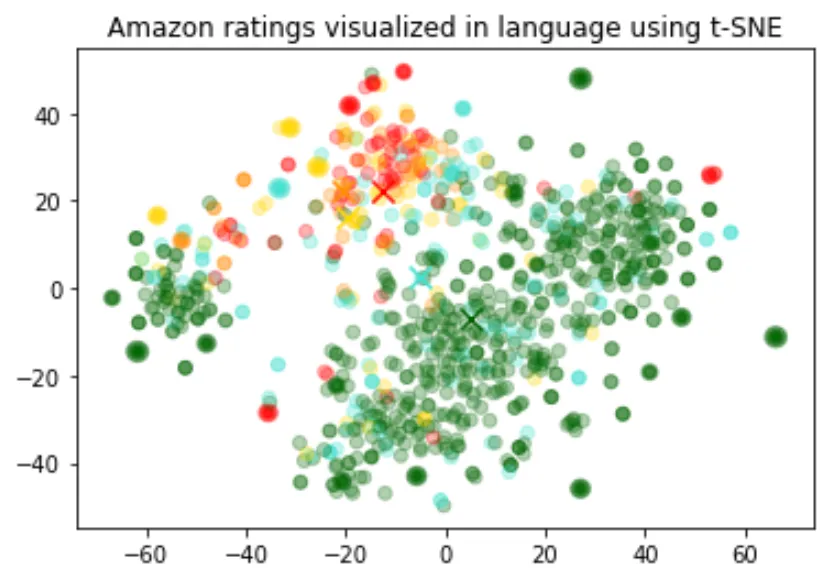
A visualização sugere cerca de três grupos, um deles formado principalmente por avaliações negativas.
1
2
3
4
5
6
7
8
9
10
11
12
13
14
15
16
17
18
19
20
21
22
23
24from ast import literal_eval
import numpy as np
import pandas as pd
from sklearn.manifold import TSNE
import matplotlib.pyplot as plt
import matplotlib

df = pd.read_csv("output/embedded_1k_reviews.csv")
matrix = np.array(df.ada_embedding.apply(literal_eval).to_list())

# Create a t-SNE model and transform the data
tsne = TSNE(
    n_components=2, perplexity=15, random_state=42, init="random", learning_rate=200
)
vis_dims = tsne.fit_transform(matrix)

colors = ["red", "darkorange", "gold", "turquoise", "darkgreen"]
x = [x for x, y in vis_dims]
y = [y for x, y in vis_dims]
color_indices = df.Score.values - 1

colormap = matplotlib.colors.ListedColormap(colors)
plt.scatter(x, y, c=color_indices, cmap=colormap, alpha=0.3)
plt.title("Amazon ratings visualized in language using t-SNE")Em modelos de aprendizado de máquina, os embeddings podem servir como codificadores de atributos para textos livres em geral. Incorporar embeddings melhora o desempenho de qualquer modelo de aprendizado de máquina quando parte das entradas relevantes está em texto livre. Os embeddings também podem codificar atributos categóricos nesses modelos. Isso é particularmente útil quando há muitos nomes de categorias e eles têm significado próprio, como os nomes de cargos. Para essa tarefa, os embeddings de similaridade geralmente têm desempenho melhor que os embeddings de busca.
Observamos que, em geral, a representação por embeddings concentra muita informação. Por exemplo, reduzir a dimensionalidade das entradas com SVD ou PCA, mesmo que em apenas 10%, costuma prejudicar o desempenho nas tarefas específicas que usam essas entradas.
O código a seguir divide os dados em um conjunto de treinamento e outro de teste. Usaremos esses conjuntos nos dois próximos casos de uso, regressão e classificação.
1
2
3
4
5from sklearn.model_selection import train_test_split

X_train, X_test, y_train, y_test = train_test_split(
    list(df.ada_embedding.values), df.Score, test_size=0.2, random_state=42
)
Regressão com os atributos dos embeddings
Os embeddings oferecem uma maneira simples de prever valores numéricos. Neste exemplo, prevemos quantas estrelas o usuário atribuiu ao produto com base no texto da avaliação. Como os embeddings contêm muita informação semântica, a previsão é razoável mesmo com pouquíssimas avaliações.
Tratamos a nota como uma variável contínua entre 1 e 5 e permitimos que o algoritmo preveja qualquer valor de ponto flutuante. O algoritmo de aprendizado de máquina minimiza a distância entre o valor previsto e a nota real e alcança um erro absoluto médio de 0,39. Ou seja, em média, a previsão difere da nota real em menos de meia estrela.
1
2
3
4
5from sklearn.ensemble import RandomForestRegressor

rfr = RandomForestRegressor(n_estimators=100)
rfr.fit(X_train, y_train)
preds = rfr.predict(X_test)Desta vez, em vez de prever um valor qualquer entre 1 e 5, o algoritmo tenta identificar o número exato de estrelas de cada avaliação. Para isso, classifica as avaliações em cinco categorias, de 1 a 5 estrelas.
Após o treinamento, o modelo prevê as notas das avaliações de 1 e 5 estrelas muito melhor do que as das avaliações mais sutis (de 2 a 4 estrelas), provavelmente porque os usuários expressam opiniões mais extremas nas notas mais baixas e mais altas.
1
2
3
4
5
6from sklearn.ensemble import RandomForestClassifier
from sklearn.metrics import classification_report, accuracy_score

clf = RandomForestClassifier(n_estimators=100)
clf.fit(X_train, y_train)
preds = clf.predict(X_test)Podemos usar embeddings para classificação zero-shot sem dados de treinamento rotulados. Para cada classe, geramos um embedding a partir de seu nome ou de uma breve descrição. Para classificar um novo texto com a técnica zero-shot, comparamos seu embedding com os embeddings de todas as classes e escolhemos a classe com a maior similaridade.
1
2
3
4
5
6
7
8
9
10
11
12
13
14
15
16
17
18
19
20
21import OpenAI from "openai";

const client = new OpenAI();
const labels = ["negative", "positive"];

const { data } = await client.embeddings.create({
  model: "text-embedding-3-small",
  input: [...labels, "The coffee arrived quickly and tastes great."],
});

const review = data.at(-1).embedding;
const similarity = (embedding) => {
  const dotProduct = embedding.reduce(
    (total, value, index) => total + value * review[index],
    0
  );
  return dotProduct / (Math.hypot(...embedding) * Math.hypot(...review));
};

const [negative, positive] = data.map(({ embedding }) => similarity(embedding));
console.log(positive > negative ? "positive" : "negative");
1
2
3
4
5
6
7
8
9
10
11
12
13
14
15
16
17
18df = df[df.Score != 3]
df["sentiment"] = df.Score.replace(
{1: "negative", 2: "negative", 4: "positive", 5: "positive"}
)
labels = ["negative", "positive"]
label_embeddings = [get_embedding(label, model=model) for label in labels]
def label_score(review_embedding, label_embeddings):
return cosine_similarity(review_embedding, label_embeddings[1]) - cosine_similarity(
review_embedding, label_embeddings[0]
)
prediction = (
"positive" if label_score(get_embedding("Sample Review", model=model), label_embeddings) > 0 else "negative"
)1
2
3
4
5
6
7
8
9
10
11
12
13
14
15
16
17
18
19
20
21
22
23
24
25
26
27
28
29
30
31
32
33
34
35
36
37
38
39
40
41
42
43
44
45
46
47
48
49
50
51
52
53
54
55
56
57
58
59import (
"context"
"fmt"
"log"
"math"
"github.com/openai/openai-go/v3"
)
func main() {
if err := run(); err != nil {
log.Fatal(err)
}
}
func run() error {
client := openai.NewClient()
ctx := context.Background()
negative, err := embedding(ctx, &client, "negative")
if err != nil {
return err
}
positive, err := embedding(ctx, &client, "positive")
if err != nil {
return err
}
review, err := embedding(ctx, &client, "Sample Review")
if err != nil {
return err
}
score := cosineSimilarity(review, positive) - cosineSimilarity(review, negative)
prediction := "negative"
if score > 0 {
prediction = "positive"
}
fmt.Println(prediction)
return nil
}
func embedding(ctx context.Context, client *openai.Client, text string) ([]float64, error) {
response, err := client.Embeddings.New(ctx, openai.EmbeddingNewParams{
Model: openai.EmbeddingModelTextEmbedding3Small,
Input: openai.EmbeddingNewParamsInputUnion{OfString: openai.String(text)},
})
if err != nil {
return nil, err
}
return response.Data[0].Embedding, nil
}
func cosineSimilarity(a, b []float64) float64 {
var dot, left, right float64
for i := range a {
dot += a[i] * b[i]
left += a[i] * a[i]
right += b[i] * b[i]
}
return dot / math.Sqrt(left*right)
}1
2
3
4
5
6
7
8
9
10
11
12
13
14
15
16
17
18
19import com.openai.client.OpenAIClient;
import com.openai.client.okhttp.OpenAIOkHttpClient;
import com.openai.models.embeddings.EmbeddingCreateParams;
import java.util.List;
var embeddings =
client
.embeddings()
.create(
EmbeddingCreateParams.builder()
.model("text-embedding-3-small")
.inputOfArrayOfStrings(List.of("negative", "positive", "Sample Review"))
.build())
.data();
List<Float> review = embeddings.get(2).embedding();
double negative = cosineSimilarity(review, embeddings.get(0).embedding());
double positive = cosineSimilarity(review, embeddings.get(1).embedding());
System.out.println(positive > negative ? "positive" : "negative");1
2
3
4
5
6
7
8
9
10
11
12
13
14
15
16
17
18
19
20
21
22
23
24
25
26
27
28
29using OpenAI.Embeddings;
string key = Environment.GetEnvironmentVariable("OPENAI_API_KEY")!;
string model = "text-embedding-3-small";
EmbeddingClient client = new(model, key);
float[] negative = await EmbedAsync(client, "negative");
float[] positive = await EmbedAsync(client, "positive");
float[] review = await EmbedAsync(client, "Sample Review");
double score = CosineSimilarity(review, positive) - CosineSimilarity(review, negative);
Console.WriteLine(score > 0 ? "positive" : "negative");
static async Task<float[]> EmbedAsync(EmbeddingClient client, string text)
{
OpenAIEmbedding result = await client.GenerateEmbeddingAsync(text);
return result.ToFloats().ToArray();
}
static double CosineSimilarity(float[] left, float[] right)
{
double dot = 0, leftNorm = 0, rightNorm = 0;
for (int i = 0; i < left.Length; i++)
{
dot += (double)left[i] * right[i];
leftNorm += (double)left[i] * left[i];
rightNorm += (double)right[i] * right[i];
}
return dot / Math.Sqrt(leftNorm * rightNorm);
}1
2
3
4
5
6
7
8
9
10
11
12
13
14
15
16
17
18
19
20
21
22require "openai"
client = OpenAI::Client.new
labels = ["negative", "positive"]
response = client.embeddings.create(
model: "text-embedding-3-small",
input: labels + ["The coffee arrived quickly and tastes great."]
)
review = response.data.fetch(-1).embedding
similarity = lambda do |embedding|
dot_product = embedding.zip(review).sum { |value, review_value| value * review_value }
magnitude = Math.sqrt(embedding.sum { |value| value**2 })
review_magnitude = Math.sqrt(review.sum { |value| value**2 })
dot_product / (magnitude * review_magnitude)
end
negative, positive = response.data.first(2).map do |embedding|
similarity.call(embedding.embedding)
end
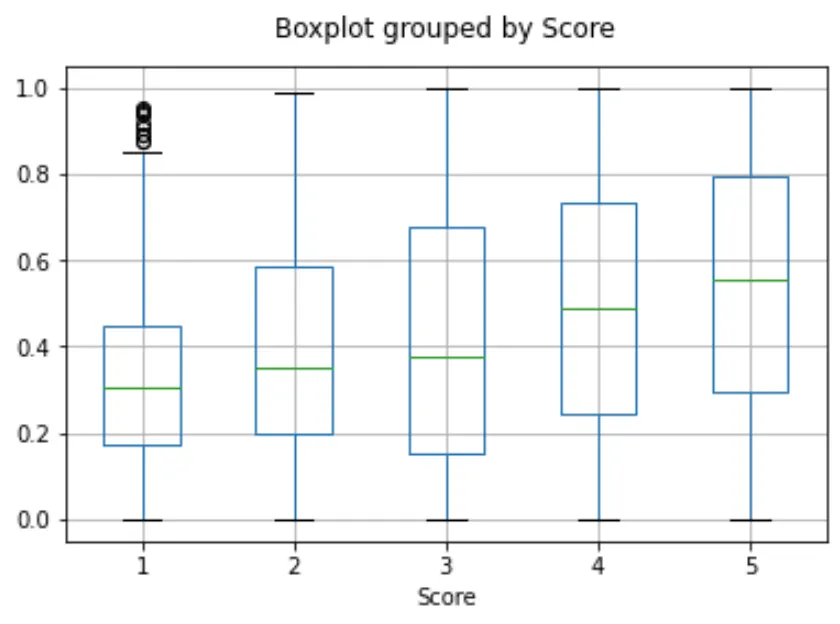
puts((positive > negative) ? "positive" : "negative")Podemos obter o embedding de um usuário calculando a média dos embeddings de todas as avaliações que ele publicou. Da mesma forma, podemos obter o embedding de um produto calculando a média dos embeddings de todas as avaliações desse produto. Para demonstrar a utilidade dessa abordagem, usamos um subconjunto de 50 mil avaliações que inclui mais avaliações por usuário e por produto.
Para verificar a utilidade desses embeddings, usamos um conjunto de teste separado e traçamos um gráfico da similaridade entre o embedding do usuário e o do produto em função da nota. Com essa abordagem, mesmo antes de o usuário receber o produto, conseguimos prever se ele vai gostar do produto com mais acerto do que se escolhêssemos a resposta ao acaso.
user_embeddings = df.groupby("UserId").ada_embedding.apply(np.mean)
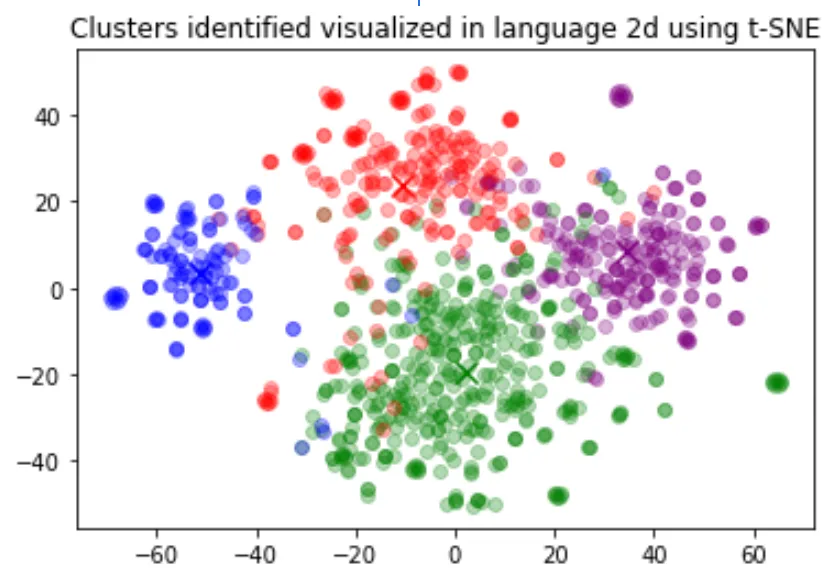
prod_embeddings = df.groupby("ProductId").ada_embedding.apply(np.mean)O agrupamento é uma forma de interpretar grandes volumes de dados textuais. Os embeddings são úteis para essa tarefa porque representam o significado de cada texto na forma de um vetor. Assim, o agrupamento revela grupos ocultos no conjunto de dados sem necessidade de supervisão.
Neste exemplo, identificamos quatro grupos distintos. Um reúne avaliações sobre ração para cães, outro reúne avaliações negativas e os dois restantes reúnem avaliações positivas.
1
2
3
4
5
6
7
8
9import numpy as np
from sklearn.cluster import KMeans

matrix = np.vstack(df.ada_embedding.values)
n_clusters = 4

kmeans = KMeans(n_clusters=n_clusters, init="k-means++", random_state=42)
kmeans.fit(matrix)
df["Cluster"] = kmeans.labels_
Perguntas frequentes
Como saber quantos tokens um texto tem antes de gerar seu embedding?
Em Python, você pode dividir um texto em tokens com o tokenizador tiktoken da OpenAI.
Exemplo de código:
1
2
3
4
5
6
7
8
9
10
11import tiktoken


def num_tokens_from_string(string: str, encoding_name: str) -> int:
    """Returns the number of tokens in a text string."""
    encoding = tiktoken.get_encoding(encoding_name)
    num_tokens = len(encoding.encode(string))
    return num_tokens


num_tokens_from_string("tiktoken is great!", "cl100k_base")
Para modelos de embeddings de terceira geração, como text-embedding-3-small, use a codificação cl100k_base.
Veja mais detalhes e exemplos de código no guia do OpenAI Cookbook sobre como contar tokens com tiktoken.
Como recuperar rapidamente os K vetores de embedding mais próximos?
Para fazer buscas rápidas entre muitos vetores, recomendamos usar um banco de dados vetorial. Você encontra exemplos de como usar bancos de dados vetoriais com a API da OpenAI no nosso Cookbook no GitHub.
Qual função de distância devo usar?
Recomendamos a similaridade de cosseno. Em geral, a escolha da função de distância faz pouca diferença.
Os embeddings da OpenAI são normalizados para que cada vetor tenha norma igual a 1. Isso significa que:
- É possível calcular a similaridade de cosseno um pouco mais rápido usando apenas o produto escalar
- A similaridade de cosseno e a distância euclidiana produzem exatamente a mesma ordenação dos resultados
Posso compartilhar meus embeddings online?
Sim. Os clientes são titulares dos dados que fornecem aos nossos modelos e dos resultados que recebem, inclusive dos embeddings. Você é responsável por garantir que o conteúdo que envia à nossa API não viole nenhuma lei aplicável nem nossos Termos de Uso.
Os modelos de embeddings V3 têm conhecimento de eventos recentes?
Não. Os modelos text-embedding-3-large e text-embedding-3-small não têm conhecimento de eventos ocorridos após setembro de 2021. Em geral, essa limitação tem menos impacto do que teria em modelos de geração de texto, mas pode reduzir o desempenho em alguns casos específicos.