
Restaurant reservation conversion plugins in ChatGPT are currently in beta and being tested with approved partners. To apply for access, fill out this form
here
Purpose
Our goal is to let ChatGPT directly invoke partner plugins for high-intent use cases such as restaurant reservations.
Once partners provide us with a feed for search, we can connect their MCP servers for bottom-of-funnel conversion actions. To do this, partner plugins must follow a standardized contract for widget name, tool name, and tool input.
If you want to build a plugin that follows this spec, apply for access through the ChatGPT merchants form.
User experience
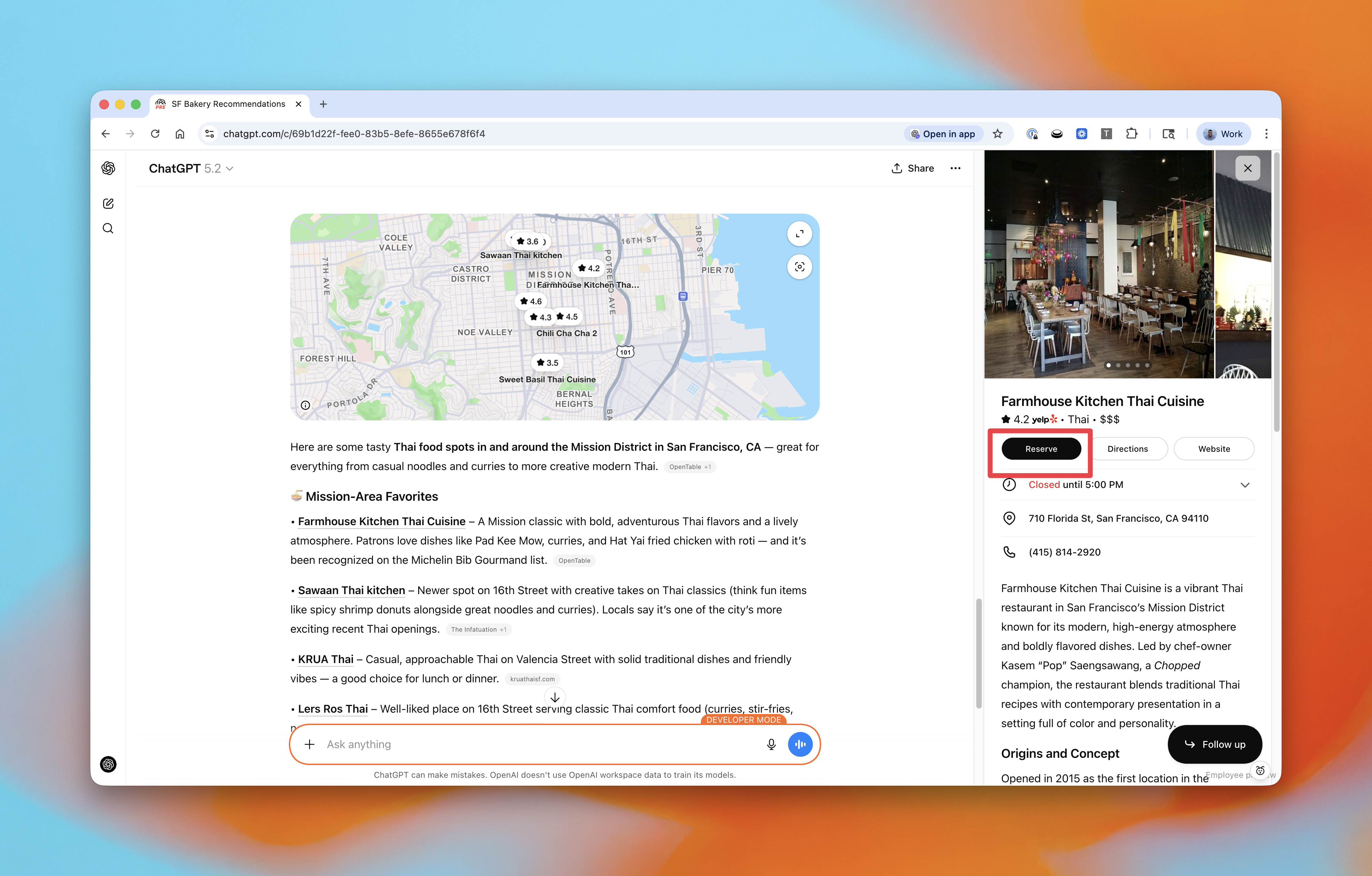
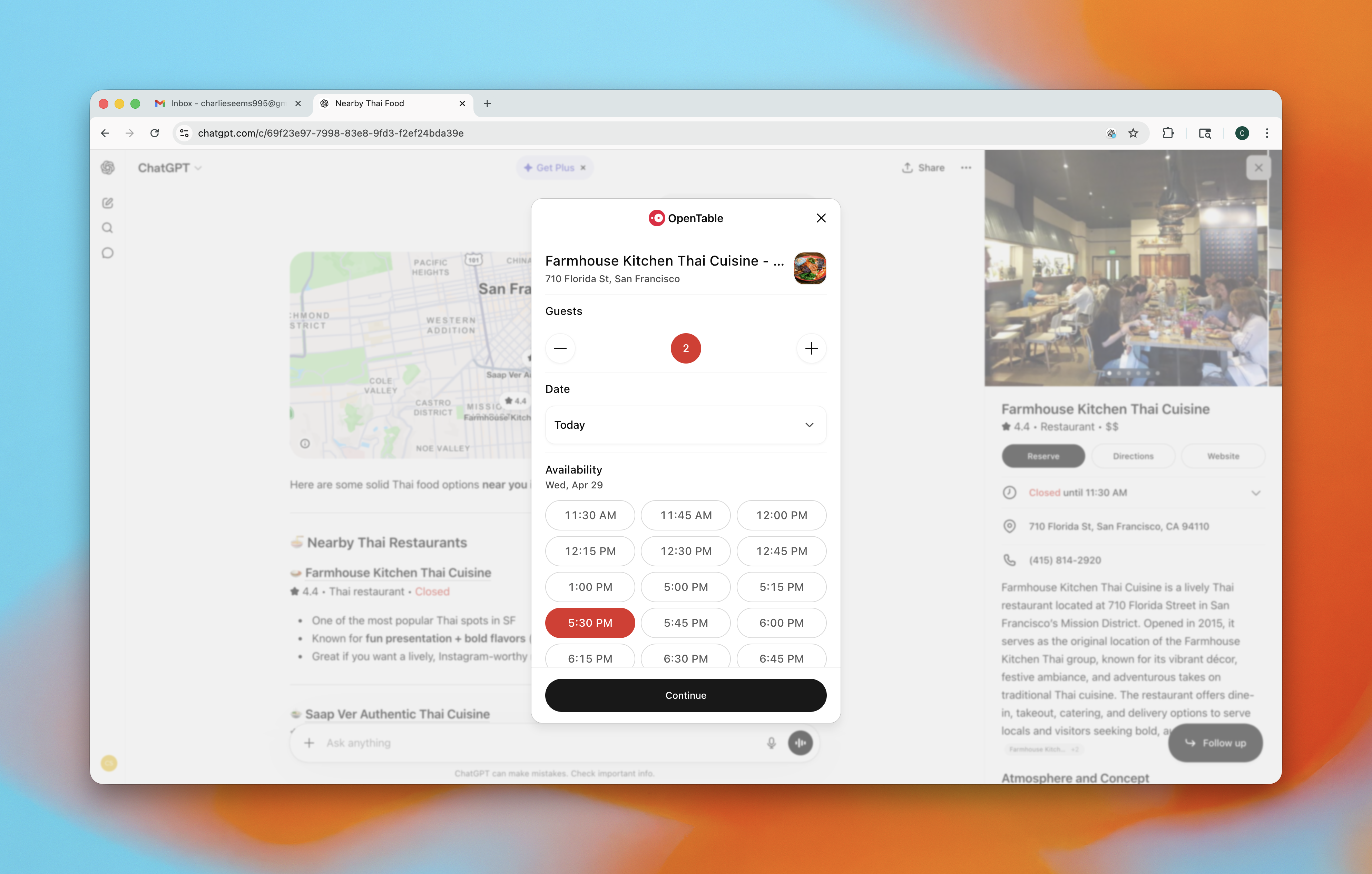
When users search for restaurants around them, the restaurant entity card and sidebar include a Reserve button that can open the restaurant’s reservation provider UI.
Reserve button in restaurant UI:
Reservation modal opened from that button:
Required contract (today)
For the current reservation integration, only the following are required:
- Widget name:
ui://widget/restaurant-reservation.html - Tool name:
restaurant_reservation
restaurant_reservation must set:
_meta.ui.resourceUri = "ui://widget/restaurant-reservation.html";Any tool called directly from a widget must set:
_meta["openai/widgetAccessible"] = true;restaurant_reservation input
Minimum payload (always sent):
{
  "restaurant_id": "string"
}
We might also send the payload below. You can use it for optimistic rendering in the modal (for example, to avoid skeleton/loading states while data hydrates):
{
  "restaurant_name": "string",
  "restaurant_image": "string",
  "restaurant_address": {
    "address": "string",
    "city": "string",
    "state": "string",
    "zipcode": "string",
    "country": "string"
  }
}
Feed requirement (search integration)
To enable Reserve-button routing, we ingest a business feed from partners.
Purpose and scope
This feed contract defines:
- Minimum business data required for matching and ranking.
- A paginated listing API.
- Change detection so we can avoid unnecessary full fetches.
Business record (minimum required fields)
A Business object must include:
id(string): stable and unique within the provider.name(string)address(objector formattedstring)location(objectwith latitude/longitude)phone_number(string, E.164 preferred)website_url(string, URL)platform_url(string, URL to your canonical listing)
Recommended minimal shape:
{
  "id": "biz_123",
  "name": "Acme Coffee",
  "address": {
    "line1": "123 Market St",
    "line2": "Suite 5",
    "locality": "San Francisco",
    "region": "CA",
    "postal_code": "94105",
    "country": "US",
    "formatted": "123 Market St, Suite 5, San Francisco, CA 94105, US"
  },
  "location": {
    "latitude": 37.793,
    "longitude": -122.396
  },
  "phone_number": "+14155551234",
  "website_url": "https://acmecoffee.example",
  "platform_url": "https://provider.example/biz/biz_123"
}
If structured address components are unavailable, address may be a single
formatted string, but it must be consistent and human-readable.
Paginated listing endpoint
Endpoint example:
GET /v1/businesses
Query parameters:
- Pagination: use one style
page+page_sizeoffset+limit- or
next_page_token(opaque token; preferred when supported) changes_token(string, optional): indicates whether data changed since the last sync checkpoint.
Response must include:
checksum(boolean): whether anything changed since the providedchanges_token(ortrueif none was provided).businesses(Business[]): current page payload.- Pagination metadata for your selected style:
page,page_size,total_pages(optional), oroffset,limit,total(optional), ornext_page_token(string | null)
Example request and response
Request:
GET /v1/businesses?page=1&page_size=2&changes_token=sync_2026_03_10Response:
{
  "checksum": true,
  "page": 1,
  "page_size": 2,
  "total_pages": 120,
  "businesses": [
    {
      "id": "biz_123",
      "name": "Acme Coffee",
      "address": {
        "line1": "123 Market St",
        "locality": "San Francisco",
        "region": "CA",
        "postal_code": "94105",
        "country": "US",
        "formatted": "123 Market St, San Francisco, CA 94105, US"
      },
      "location": {
        "latitude": 37.793,
        "longitude": -122.396
      },
      "phone_number": "+14155551234",
      "website_url": "https://acmecoffee.example",
      "platform_url": "https://provider.example/biz/biz_123"
    },
    {
      "id": "biz_124",
      "name": "Golden Diner",
      "address": "200 Howard St, San Francisco, CA 94105, US",
      "location": {
        "latitude": 37.789,
        "longitude": -122.391
      },
      "phone_number": "+14155559876",
      "website_url": "https://goldendiner.example",
      "platform_url": "https://provider.example/biz/biz_124"
    }
  ]
}
How we use this feed for search
We treat the business feed as a search index. At query time, we retrieve candidates with fuzzy matching (name + location/address), then rank and remove duplicates using name/address similarity, with location/phone/URL as additional signals.
Good-to-have expansion (not required today)
For full end-to-end in-chat completion, we recommend adding:
refresh_availabilitymake_reservationreservation_confirmation