
Local control-plane app for running and observing Agents SDK demo projects.
Prerequisites
uvnpm- Docker, when using the default
local-dockertarget
Run
make runOpen:
http://127.0.0.1:8732Vite builds the React UI from frontend/ into dist/, and the Flask backend
serves dist/ plus /api/*.
Screenshots
Deployments
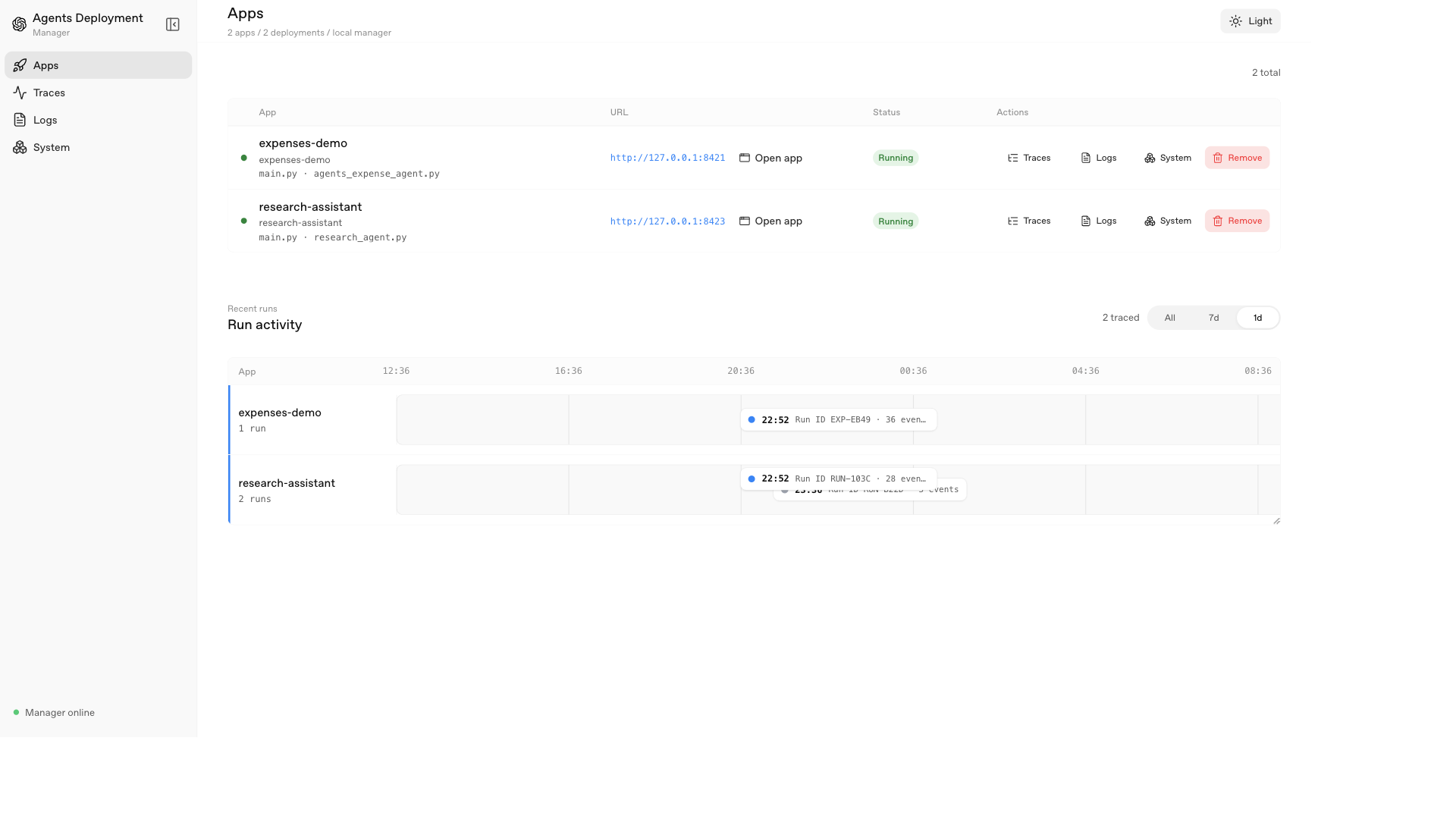
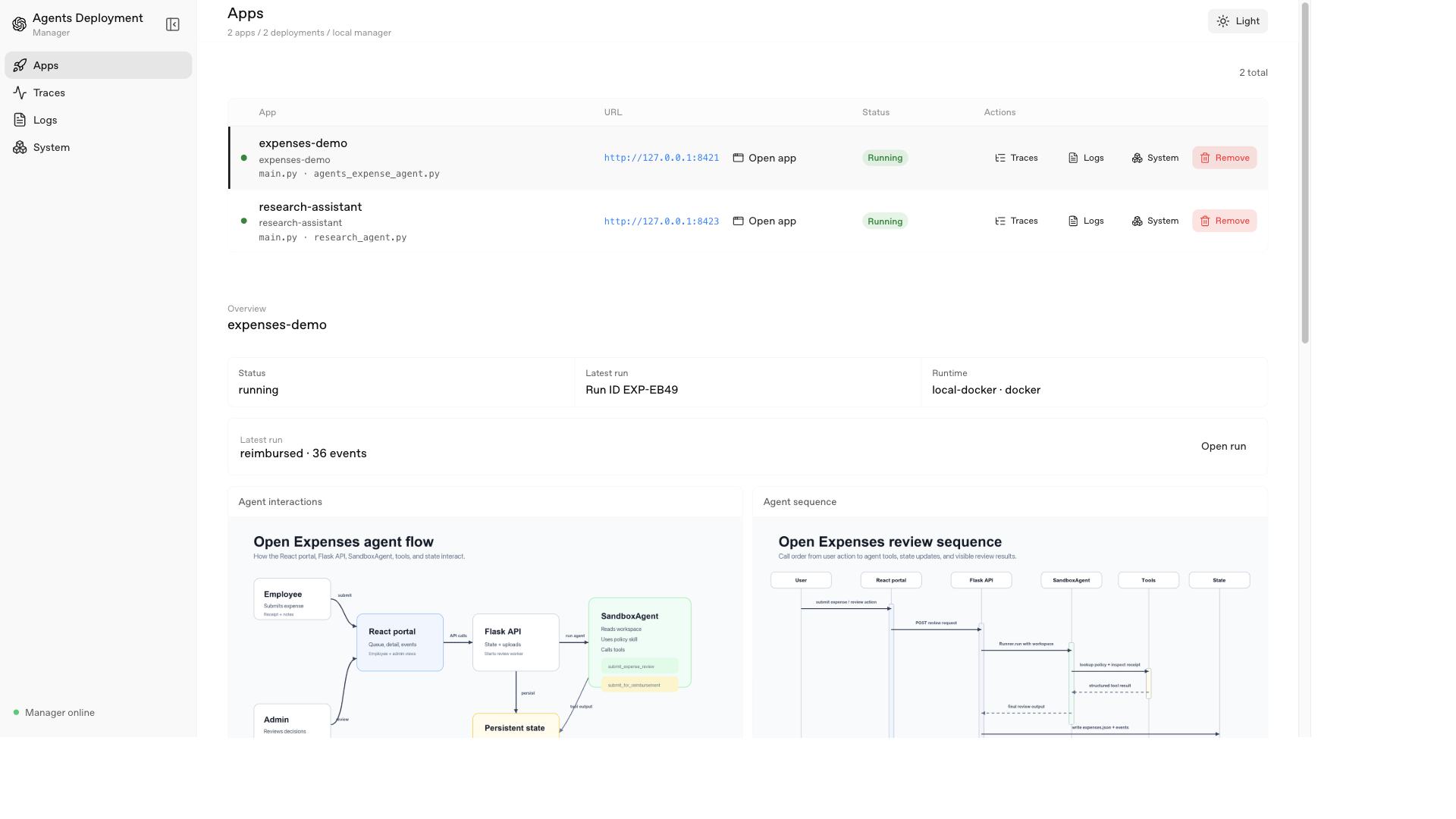
App details
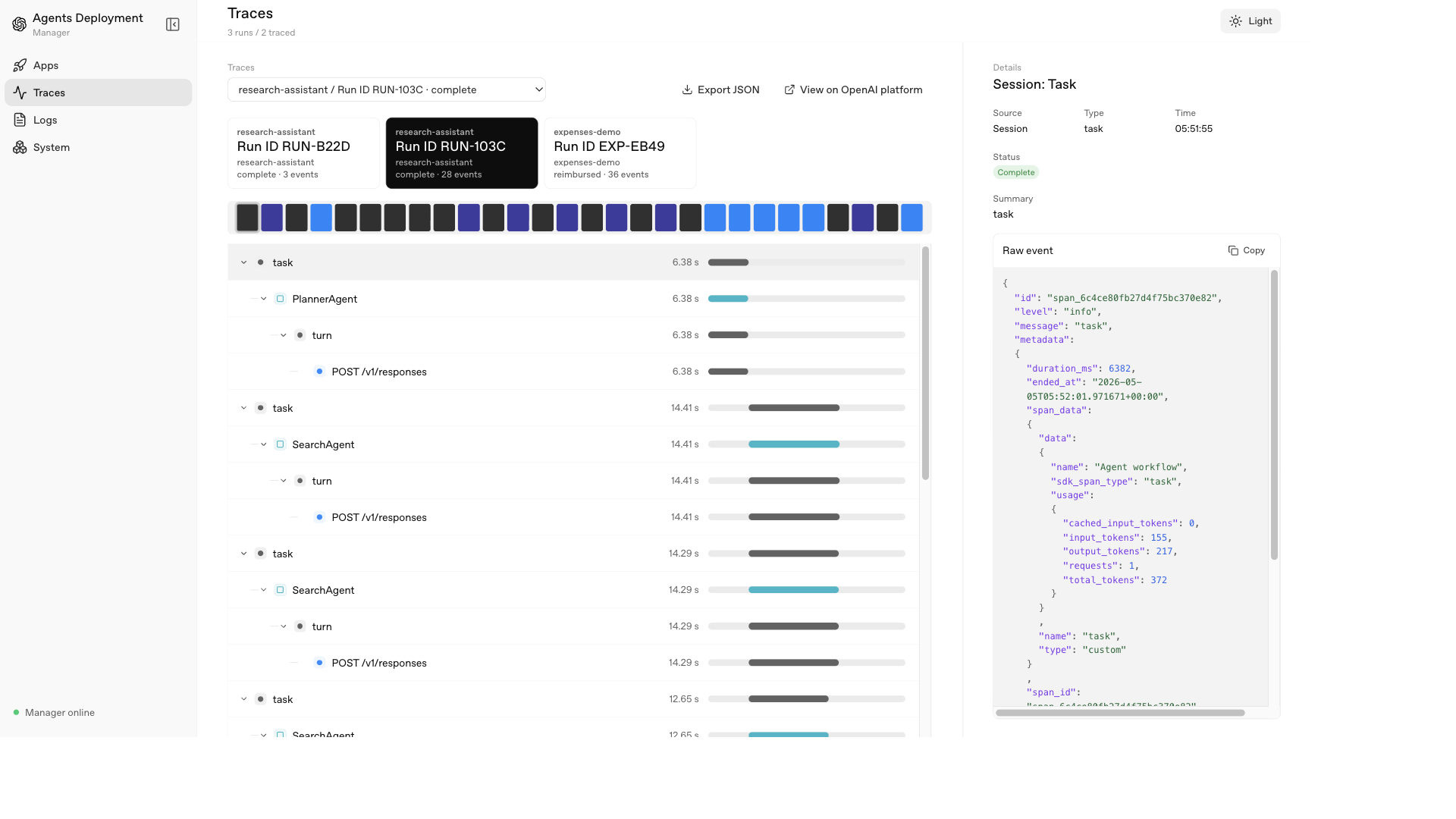
Traces
Scope
- Import a local Agents SDK project.
- Inspect entrypoints, dependencies, env vars, and sandbox usage.
- Create a local deployment record.
- Start and stop the app/orchestrator as a labeled Docker container by default.
- Generate or reuse an app-level Dockerfile for containerized deployment.
- Show deployment logs, traces, app events, and Docker container activity.
- Label sandbox containers with
agents-sdk.*metadata so the manager can map a Docker container back to its deployment and run.
For Docker deployments, the default target builds an app Dockerfile and runs the orchestrator with:
docker run -p 127.0.0.1:<app-port>:<app-port> -v /var/run/docker.sock:/var/run/docker.sock ...The Docker socket mount lets SandboxAgent create sandbox containers through Docker.
The manager sets AGENTS_SDK_MANAGER, AGENTS_SDK_PROJECT,
AGENTS_SDK_DEPLOYMENT_DATA_DIR, and AGENTS_SDK_MANAGER_TRACE_ENDPOINT on the
app process. Trace capture is posted back to the manager and stored in the
manager-owned SQLite database.
Deployable App Contract
Apps deployed through this manager should have:
pyproject.tomlwithopenai-agentsin the dependencies.main.pyas the app entrypoint.PORTsupport for local startup.uv run python main.pystarting the HTTP service whenPORTis set.- A
/healthreadiness endpoint.
Keep CLI-only smoke behavior behind explicit arguments or the no-PORT path so
the generated Dockerfile can start the service reliably.
Tracing
Tracing is captured locally through the manager’s HTTP ingestion endpoint while the Agents SDK still streams traces to the OpenAI Platform through its default processor.
When the manager starts an app it adds runtime/trace_capture to PYTHONPATH
and sets:
AGENTS_SDK_MANAGER_TRACE_ENDPOINT=http://<manager-host>:8732/api/traces/ingest
AGENTS_SDK_DEPLOYMENT_ID=<deployment-id>
AGENTS_SDK_PROJECT_ID=<project-id>
For local-process deployments <manager-host> is 127.0.0.1. For Docker
deployments it is host.docker.internal so the container can reach the manager
running on the host.
The runtime package uses sitecustomize.py to install a lightweight Agents SDK
trace processor inside the app process with add_trace_processor(). That adds a
second local destination without replacing the SDK’s default OpenAI Platform
exporter. The local processor posts exported trace records to the manager:
trace_starttrace_endspan_startspan_end
The manager stores traces in state/traces.sqlite3. The backend reads that
SQLite store in app/timeline.py, groups records by trace_id, derives the run
key from trace metadata (expense_id, run_id, or session_id), then falls
back to group_id and finally the trace_id. The UI uses those reconstructed
records for the Traces view, nested span list, event detail pane, trace deep
links via ?trace_id=..., and JSON export.
This means local tracing keeps working without bind-mounting trace files into app containers and without fetching spans from the OpenAI Platform dashboard API.
Make Targets
make start
make health
make deploy PROJECT_PATH=/path/to/agents-sdk-app APP_PORT=8421 SANDBOX_BACKEND=docker
make deploy PROJECT_PATH=/path/to/agents-sdk-app APP_PORT=8421 TARGET=local-process
make stop